More-than-human governance experiments in Europe

Executive Summary

What if we lived in a world where all living things contributed their intelligence to the decisions made about our futures.

There is a growing network of people and places exploring and practising how governance and policy design can draw on more-than-human intelligences.

‘More-than-human’ was initially coined by David Abram in his 1997 book The Spell of the Sensuous. The term refers to the animate earth and the impossibility of separating our human- ness from our relationship with it. Our exploration related to governance has been around how we might meaningfully consider our relationship with the living world when taking decisions.

We have undertaken a short exploratory research project to learn who is conducting new governance experiments in Europe to begin to map the field, learn from best practices, and share these findings. We convened a day-long learning exchange in the Netherlands on 18 June 2024 with many of the people involved in the projects that we discovered. This paper synthesises the findings and outcomes.

Key takeaways

While most of the practitioners did not know one another, there was a striking similarity in the language that most were using to describe the work that they’re doing. Sometimes the words or terminologies used were emphasised as being intentionally chosen, often in opposition to commonly used terms in the world of governance. The words and concepts that we noticed coming up over again include: entanglement; ‘living’ documents / bills / contracts; relationships and relationality; protocols, as well as reciprocity and care.

There were three main types of approaches to applying the idea of more-than-human governance in practice, sometimes with an overlap:

  • Rights-based;
  • Representation-focused, and
  • Artistic.

We identified four key groups we felt were missing from our initial research and discussions:

  • Indigenous voices;
  • More non-specialists and artists;
  • A few critical voices, and
  • People using technology in novel ways that reshape our relationship with the living world.

We sense that this is both an emergent and interdisciplinary space. In connecting with people and organisations engaging with this work, it seems that this is not so much a recognised ‘field’ as a community of practice or practices, at an emergent stage. Most of those attending the convening noted that through the event, they had made contact with and learned about work that was unknown to them previously.

There was a sense of solidarity and allyship that those present were keen to lean into.

At the same time, there was also some note of scepticism expressed about whether this should become a ‘field’.

We found that those working on these ideas come from a wide range of disciplines and angles, and are often collaborating with one another across those lines.

Ways forward

We identified numerous opportunities and challenges for the future of this practice. The opportunities largely centre around the possibilities that emerge from a growing number of people who are beginning to become better aware of one another’s work to support and collaborate with each other, with a desire to catalyse it further. The challenges revolve around making these ideas and this work inclusive to a wider array of people and the risk currently posed by it being seen as elitist, niche, or out-of-touch by many people who feel like politics is failing both humans and the natural world.

Other challenges include the funding needed for further experimentation and evaluation, as well as the tensions raised by the various approaches and that it remains far from obvious how or if one can or should meaningfully involve the more-than-human world in governance.

Five next steps that we feel would be useful both for our own work, and the growing community of practitioners in this space entail:

  1. Greater exploration of and conversation with Indigenous voices and wisdoms - in Europe and beyond;
  2. Research into past practices, such as medieval animal trials and other practices that are little known today;
  3. An exploration of the technology angle, about how AI advances are creating new opportunities for communicating more directly with the living world and the legal and political implications of this trend;
  4. An exploration of the principles or foundational frameworks that could be codified into governance practices that could make a shift in the direction of a new relationship between the human and more-than-human - for example, the acknowledgement that humans are not separate from nature.
  5. Further spaces for conversation, exploration and sharing - in person and possibly online - with a broader range of constituents. This should include constructive conversations with critics or sceptics of these approaches to lean into the tensions, and sharpen the practices as well as the intellectual reasoning behind them.

What's next?

We welcome further reflections and connections to other work exploring these questions in European contexts, including work that draws inspiration from indigenous or global practices. We will continue to reference further examples on our website. Our hope is that these explorations create new connections and collaborations.

Within DemocracyNext, we hope to continue exploring what these ideas may mean for our own work on democratic innovation. For Arising Quo, this project is part of our strategic learning about signals and opportunities for transformation, which will play into future grantmaking of Arising Quo and possibly that of other wealth holders.

For further background context, DemocracyNext CEO and Founder Claudia Chwalisz wrote a short pre-convening reflection paper on her relationship with nature and the more- than-human world, and its intersection with governance and democracy.

How to cite this paper: Chwalisz, Claudia and Reid, Lucy (2024), “More-than-human governance experiments in Europe: Trends, opportunities, and challenges", DemocracyNext.

The full paper

Introduction

There is a growing network of people and places exploring and practising how governance and policy design can draw on more-than-human intelligences.

What do we mean by ‘more-than-human’? Initially coined by David Abram in his 1997 book The Spell of the Sensuous, the term refers to the animate earth and the impossibility of separating our humanness from our relationship with it. Our exploration related to governance has been around how we might meaningfully consider our relationship with the living world when taking decisions.

We have undertaken a short exploratory research project to learn who is conducting new governance experiments in Europe to begin to map the field, learn from best practices, and share these findings. This included an initial day-long learning exchange in the Netherlands on 18 June 2024, where DemocracyNext and Arising Quo brought together a group of people who have been experimenting with more-than-human governance approaches in Europe.

The questions we are exploring include:

  • Who is doing more-than-human governance practice in Europe? Or enquiring about it too?
  • Where is the work being applied into policy and governance?
  • Who is doing what, where?
  • What is emerging in this field in Europe?
  • How can this work be further supported?

In preparing for this convening, we researched these issues, interviewed practitioners, lawyers, theorists, designers, artists, and others who are experimenting with different approaches. From interspecies councils to legal approaches that give new rights to elements of the natural world and animals, to artistic practices that create embodied experiences of new governing relationships, and other examples, there has been a richness in imagination about how to potentially approach governing with the more-than-human world.

This paper represents our initial reflections, a sharing of the work and practices from those attending the learning exchange, and subsequent reflections. It is not intended to be exhaustive - more the beginnings of some shared explorations and conversations. It reflects an exploratory stage in our thinking.

We welcome further reflections and connections to other work exploring these questions in European contexts, including work that draws inspiration from indigenous or global practices. We will continue to reference further examples on our website. Our hope is that these explorations create new connections and collaborations.

Within DemocracyNext, we hope to continue exploring what these ideas may mean for our own work on democratic innovation. For Arising Quo, this project is part of our strategic learning about signals and opportunities for transformation, which will play into future grantmaking of Arising Quo and possibly that of other wealth holders.

For further background context, DemocracyNext CEO and Founder Claudia Chwalisz wrote a short pre-convening reflection paper on her relationship with nature and the more-than-human world, and its intersection with governance and democracy.

Convening participants
  • Yep — same trick, much nicer once it can breathe 😄
    I’ve split each convening participant onto its own clean line, keeping all descriptors exactly as you had them.
  • Christiane Bosman, Embassy of the North Sea (The Netherlands)
  • Isabelle Bucklow, Superflux (UK, international), virtual
  • Ieva Česnulaitytė, Head of Research and Learning, DemocracyNext (Netherlands)
  • Melanie Challenger, Animals in the Room (UK), virtual
  • Claudia Chwalisz, CEO and Founder, DemocracyNext (France)
  • Corbin LaMont, Arising Quo (UK/US), virtual
  • Maria Lucia Cruz Correia, Voice of Nature Kinstitute, Natural Contract Lab (across Europe)
  • Lara Houston, Creative Practices for Transformational Futures project (CreaTures) (EU), virtual
  • Joffrey Lavigne, Vraiment Vraiment, Les microparlements des espaces naturels (France), virtual
  • James MacDonald-Nelson, Project Lead – Urban Planning and Design, DemocracyNext (Germany)
  • Calvin Po, Dark Matter Labs, River Don Project (UK)
  • Elahe Rajabiani, European Commission, Joint Research Centre – workshop model with non-humans (EU)
  • Lucy Reid, COO, DemocracyNext (UK)
  • Eva Rovers, Bureau Burgerberaad, Assembly addressing the needs of the forest – new project (The Netherlands), virtual
  • Carlos Andrés Baquero-Diaz, MOTH (More than human) Rights Initiative (International) (US), virtual
  • Marianna Sonneck, Club Real, Organisms Democracy (Germany)
  • Robbie Stamp, Board Chair, DemocracyNext (UK)
  • Phoebe Tickell, Moral Imaginations, River Roding Interspecies Council (UK)
  • David van Reybrouck, Author, Founder, G1000, International Advisory Council Member, DemocracyNext (Belgium), virtual
Reflections

Language

While most of the practitioners did not know one another, there was a striking similarity in the language that most were using to describe the work that they’re doing. Sometimes these were emphasised as being intentionally chosen, in opposition to commonly used terms in the world of governance. The words and concepts that we noticed coming up over again include:

Entanglement - the interconnected nature of things, sometimes emphasised in opposition to ‘boundaries’.

'Living’ documents / bills / contracts - the idea that an official or legal document setting out rules and ways of being in relationship is something that should not be static, but constantly evolving.

Relationships and relationality - an emphasis on the importance of the connections between people and elements of the living world that all have agency, sometimes emphasised in opposition to objects that have no agency. It implies a sense of mutual obligations.

Protocols - used in different ways depending on the context, but many of the projects have a technical dimension to them, referring to the set of rules for governance and relationships.

Reciprocity and care - often mentioned together, the idea that relationships are not one-way and that rather than mere obligation or constraint, an approach that centres mutuality, sometimes emphasised in opposition to extraction.

Three main approaches: Rightsbased, representation-focused, and artistic

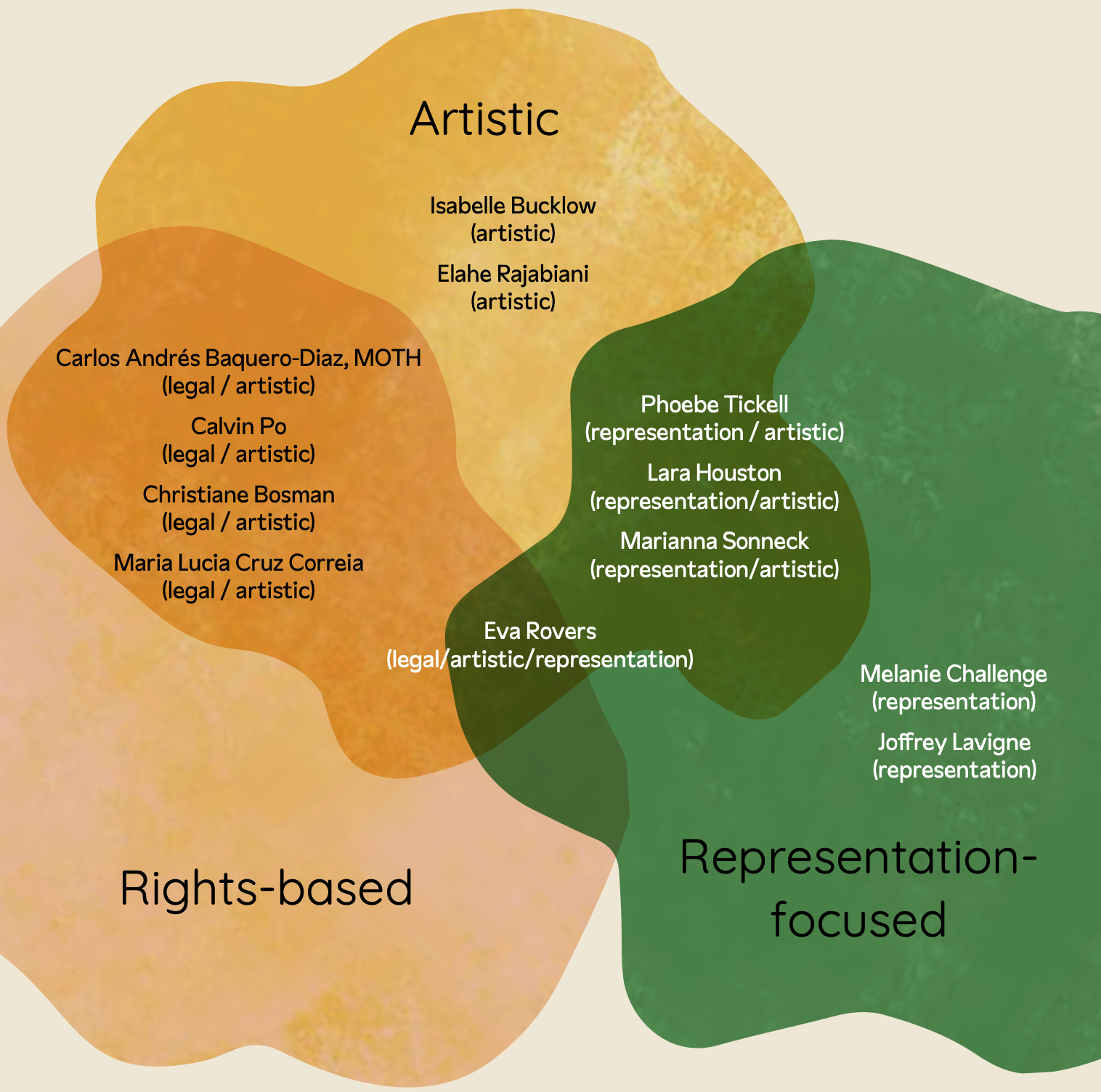
Overall, amongst the group convened, there were three main types of approaches to applying the idea of more-than-human governance in practice, sometimes with an overlap: rights-based; representationfocused, and artistic. The people and organisations who are advancing and experimenting with these different methodologies share a humility in not being fully certain that this is the ‘right’ or only way of approaching more-than-human governance, but they are trying these different methods with an open mindset of experimentation. We are at the early stages of this important quest. While there is a shared sense that it is not straightforward how to best include other beings, there is also a general belief that in principle, they should be included.

Mapping our participants

We have mapped the participants from our convening across the three approaches identified, and recognise this is only a partial view of the wider field.

Rights-based

A legalistic approach focused on ensuring rights of nature more broadly or rights of specific elements such as rivers. This approach is inspired by more long-standing and successful approaches to gain official legal rights in other parts of the world such as Latin America and New Zealand, where there has been a longer tradition of campaign groups successfully achieving such change, either in legislation or via constitutional amendments. To date, there is only one nature entity that has legal standing in Europe (the Mar Menor lagoon in Spain), whereas there are 400 elsewhere.

We are aware that we did not include an exhaustive group who are working on these issues; there is a growing number of European groups and firms similar to the UK-based Lawyers for Nature, including Client Earth, and the European Environmental Law Forum. We heard from Carlos Andrés Baquero-Diaz of the More-than-Human Life project, situated at the NYU Law School, encompassing individuals and initiatives around the world, about their combination of legal and cultural approaches to advance the rights of nature. The majority of their examples and initiatives are outside of Europe, however, we felt it was important to hear and learn from them to try and better understand what lessons might be learnt for the European landscape as well.

This approach raises a number of interesting questions, and includes an inherent tension in the separation between the rights-holder and those who have the agency to make those rights real. For instance, if a river has rights, who is responsible for making those rights tangible for it?

It also raises new types of questions regarding enforcement and social contracts. In some of the projects, like the work of Dark Matter Labs in imagining a new social contract around the River Don, there is a move away from a courts-based view of enforcement. Rather than viewing the state as a guarantor with central enforcement, it requires a mindset shift towards mutual obligation, where peerto-peer enforcement is recognised. This ties in to one of the other reflections regarding the idea of having more of a ‘living’ agreement rather than a static contract. Such approaches raise bigger questions about the impact of such changes on relationships and how we behave. It goes hand-in-hand with a shift in worldview, that the approach does not stem from a claim to “save the river”, for instance.

Robbie Stamp and David Van Reybrouck also highlighted how there is a deep historical context when it comes to such questions. The idea that we live in an interconnected web with mutual reciprocity goes back hundreds of years. In Europe, there is a long tradition that predates modern times, such as the mediaeval animal trials that took place. What can we learn from that long tradition?

Moreover, the reflections on language mentioned above translate into the way in which some of the legal work in this field is taking place. For instance, Maria Lucia Cruz Correia of the Voice of Nature Kinstitute shared that in the context of her work at the Natural Contract Lab, one of the key questions they are exploring is: “how to reimagine a protocol of reciprocal care for a body of water?” Their work to create a ‘living bill’, reimagining the writing of a law, has some similarities in spirit to the project that Calvin Po shared from Dark Matter Labs. The way that Lucia talked about the initiative was to “grow an alliance of care for the river”.

Representation-focused

The majority of the examples we explored had an approach focused on trying to find ways to represent nature in the decision-making process. This mostly included different practices that involved an element of role-playing, where participants in a deliberation were asked to put themselves in the shoes of, for example, soil, or a plant, or a river, etc. rather than to speak from their own personal perspective. This included the work presented by Phoebe Tickell of Moral Imaginations, Lara Houston of the CreaTures project, Marianna Sonneck of the Organisms Parliament, Joffrey Lavigne about the Micro-Parliament of Biodiversity, and in a certain way, the Trial in the Park project shared by Eva Rovers of the Bureau Burgberaad.

A key rationale for this approach was to spark engagement and interest, to make these approaches relatable, and to encourage participants to use their imagination. Marianna reflected the need for.development in the field of democratic processes trying to make these processes more relatable for a wide range of people with democratic rights who currently do not exercise their rights.

In the Micro-Parliament of Biodiversity project, Vraiment Vraiment and Démocratie Ouverte propose a system to bring biodiversity into political decision-making, whereby members of the new micro-parliament model are a mix of volunteers and people chosen by sortition (selection by lottery with stratification for representativeness). Those members are assigned a species, who learn the basics about that species by going out in the field to research and document. Their work entails collectively constructing proposals for biodiversity, that would be decided upon together with elected officials and public officials.

The Trial in the Park project is at the intersection of all three approaches. It entailed a speculative lawsuit, where trees became legal persons holding parliament representatives to account for climate change. Part of the approach was artistic to stage the wood, and experiment with how trees can be represented in a court of law.

Beyond role-playing, some of the examples, such as the work of Animals in the Room shared by Melanie Challenger, include direct representation of animals themselves - such as elephants. This involves using scientific data about how elephants communicate. However, there is a lot of reflection being done on how to make this something that is not merely performative, coming from a serious desire to find a way to communicate directly with animals and find ways to establish interspecies solidarity. She also highlighted that there is a distinction between representing nature in the aggregate versus a focus on a specific community of organisms.

For some of the participants in the convening, there was a critical reflection that the models and interfaces of today’s democracies, be they old-fashioned like parliaments and tribunals or innovative like citizens’ assemblies, may not be the most promising avenues of research, as they all somehow involve forms of representation of what is, with today’s knowledge of the natural, so hard to represent without being anthropocentric. While the role-playing examples might be imaginative and inspiring, it can be argued that this is hardly a basis for solid decision making. There are too many assumptions about radically different forms of agency.

Attempting to ‘represent’ nature within a deliberative process might be useful to help prompt another set of perspectives and help people to get themselves out of their own shoes as one part of a wider deliberative process, but there is equally a need to be careful that this does not become a basis for humans to be claiming legitimacy for decisions on behalf of nature either. Such a process could not stand on its own for decision-making purposes.

Artistic

Some of the examples involved artistic methodologies that included theatre, film, exhibitions, and art. These were sometimes woven into the other approaches, or sometimes on their own for the purposes of giving people an opportunity to have an embodied experience that could transform their relationship with the living world, and in doing so have an impact on how we envision governance more holistically.

Elahe Rajabiani from the EU Policy Lab, for instance, described the numerous artistic methodologies that she and her team use in the context of EU policy making. This ranged from a futures garden film to enable horizon scanning, the symbiotic film that is being used as a device to embody different types of intelligences, NaturArchy - a collaborative group of artists and scientists that are working together on an exhibition on our anthropocentric relationship with nature, a data atlas with maps of how water bodies have changed over time through human intervention that have been integrated into sculptures, as well as speculative workshops involving those sculptures where policymakers can ‘sit with the river’.

The Superflux team has also been involved in various artistic initiatives such as an immersive installation at the Venice Biennale - a rich, biodiverse forest that they called a “refuge for resurgence”. It involved a communal mean with many different species, including those that might be thought of as ‘pests’. The goal was to convey the fact that our fates are collective, and to experiment with what conversation could be had and decisions taken in such a setting?

Another example, which sits at the intersection of the artistic and representation-focused methods is the work of the Organisms Parliament, presented by Marianna Sonneck. It is a participatory theatre experience, where those who attend the Organisms Parliament are sorted into seven groups representing different species, and in each group they choose two organisms, which will be represented by the humans involved. As opposed to the Micro-Parliament of Biodiversity model described above, people do not necessarily spend time learning more in-depth about that species or try to become more expert in it before deliberating. The organisms interact in a parliament with a legislative, executive, and judicial branch that includes a constitutional court.

At the intersection of the artistic, representational, and legal approaches is the work of the Embassy of the North Sea. Christiane Bosman shared how they work with a collective of lawyers, designers, anthropologists, and other interdisciplinary actors on behalf of the North Sea, which is 62% of Dutch territory. It is the country’s largest public space, the busiest sea in the world, and it has been continually losing biomass and biodiversity but this is not in the consciousness of most people. Their starting point is that the sea owns itself, but is not properly represented as it is too often seen as an object. In September 2022, the Embassy enacted a prosecution of the Dutch government for neglecting the sea with judges and lawyers, bringing in the voices of non-humans. While it was not “real”, by doing it, it was a way of making it real.

What or who was missing from the discussions?

For this gathering we read, researched, and followed leads as a starting point for conversation. Our exploration brief was to connect with work that is happening in Europe, and it was clear that there are some countries and regions where there is some momentum building, and where it was easier to find examples of work. We reflected together on the question of who or what was missing from our research, and from the convening itself, and we made five key observations:

1. Indigenous voices in Europe.

Although indigenous perspectives and wisdoms were referenced in the conversation, and some of the work shared had been inspired by or made reference to indigenous wisdoms and practices, there was no direct representation in the room. Whilst the geographic focus was boundaried to focus on Europe for this brief, the sharing of work that centres indigenous wisdoms in European contexts (for example, the Sami, Basque, Celtic, and others) would enrich future discussions. Similarly the potential for non-European indigenous wisdoms to further influence or inspire work in Europe could also bring further richness, learning, and diversity of thought.

2. More non-academics and artists

We discussed that there is a real risk to this work being seen as an academic or fringe project. There should be an effort to include more practitioners, and people with a vocational education:

Understandably, people will wonder why so much effort is being made to give trees, animals or rivers a say, when they themselves feel they are not being heard at all… The field needs a truly inclusive strategy to make sure it can expand outside academia and ‘green groups’ into society as a whole.

- Eva Rovers

Similarly, the desire to see more arts practitioners was evoked:

The focus on governance has assembled this group who are using quite human techniques, there are many other arts practitioners attempting to tune into natural entities in different ways.

- Lara Houston

The work in the room had strong leanings towards legal and governance frameworks, drawing on human-centric techniques and artistic practice - and the intersection between these two areas. Surfacing and creating further links to practical applications of the thinking and work in this area would be very welcome, both to inspire, and support the development of this area of practice.

3. People who would challenge the ideas and the language used to describe the work - “a well-mannered critic or two”.

A number of the convening participants raised the point that it would be helpful to involve a few people who are mostly sceptical of the approaches described in this paper, but open-minded and willing to engage around these ideas, as a way of helping to strengthen the approaches being tested by better understanding weaknesses and opposition to them. This was also related to a point raised by a number of people that there is a tension between the anthropocentric, and European language paradigms - e.g. ‘parliaments’ and ‘governance’ and the more-than-human.

4. People who are using technology in novel ways to understand / involve the more-than-human world in governance.

We did not come across any such initiatives in Europe when conducting preliminary research - though that does not mean that nothing is happening as it is probable that our findings are not exhaustive. We are aware of James Bridle’s Server Farm in the UK, and there are some interesting projects happening in other parts of the world - such as the CETI initiative that has unveiled the language of whales - and it would be fascinating to explore this further, together with the legal, political, and democratic implications - and potentially controversial aspects - of such new possibilities.

An emergent, interdisciplinary field

In connecting with people and organisations engaging with this work, it seems that this is not so much a recognised ‘field’ as a community of practice or practices, at an emergent stage. Most of those attending the convening noted that through the event, they had made contact with and learned about work that was unknown to them previously. There was a sense of solidarity and allyship that those present were keen to lean into. At the same time, there was also some note of scepticism expressed about whether this should become a ‘field’, which might come from a concern that becoming too defined, or formalised - particularly at this emergent stage - might risk somehow constraining or narrowing the work, corralling it into a set of definitions too soon, and increasing the danger expressed by a number of participants of it becoming more elitist and too ‘niche’.

In preparing for the convening, we spoke with and explored the work of a range of people from different professions and different types of organisations. We found that those working on these ideas come from a wide range of disciplines and angles, and are often collaborating with one another across those lines. Some of the types of actors include:

  • Lawyers/legal
  • Multidisciplinary Artists/the arts
  • Writers and thinkers
  • Community practitioners
  • Ecologists
  • Conservationists
  • Academics
  • Community activists
  • Systems thinkers
  • Citizen science practitioners
  • Governments
  • Civil Society Organisations
  • Indigenous wisdoms
  • Climate campaigners
  • National and international nature NGOs
Opportunities and challenges

The convening participants highlighted a number of opportunities as well as challenges for the future of their own work as well as the wider field going forward.

Opportunities

The convening revealed that there is a nascent community, keen to connect, collaborate and learn from each other. There is also growing interest and inspiration to draw upon. A critical mass is forming, including a host of exciting practices, and the potential for connections. There are opportunities to take small but profound steps, and to engage more at policy-making level.

There currently seems to be little connection between those who are working on more-than-human approaches and those working on democratic innovation. There is an opportunity in connecting these networks and ideas more closely with one another.

We are situated at a time where there is a widespread sense that we need different forms of decision-making and our existing institutions and processes are not doing a great job of exploring these. We are equally living in a moment where there is heightened awareness of the need to change in the face of the climate emergency, and to some extent a growing awareness that the anthropocentric standpoint is failing and leading to disaster and a need for different forms of decision making, it opens the door to such experimentations.

The urgent need for action: Facing biodiversity and democracy crises, it is urgently necessary to imagine and create debate spaces for debate and dialogue, in order to formulate common solutions regarding the preservation and the restoration of biodiversity.

- Joffrey Lavigne

The convening revealed that there is already a great deal of overlapping language being used amongst practitioners, which differs from the status quo in the traditional governance community. Becoming more aware of this and intentional and consistent about language is another way in which these ideas may be able to get wider traction

Challenges

The biggest challenge highlighted by most convening participants in various ways relates to inclusion. There is a risk of losing people in our attempts to include the more-than-human. The work needs to be relevant to people’s everyday lives so that it does not come across as a niche or elitist interest. This relates to the positioning and language as well. How we talk about this work needs to become more accessible, involve a wider range of people, including from non-specialist backgrounds.

The interface with ‘power’ and how to make change happen. What are the next steps to bridge more concretely to where decisions are made? It is perhaps helpful to note here that the term ‘more-than-human’ is not seen as neutral language to many policy-makers in associated fields. The risk is that this may also therefore exclude or alienate some of the audiences who could effect or advocate for change from engaging: this is a different but equally important consideration around the use of language, and inclusion. ’ It could therefore be strategic to adapt the terminology used depending on the audience.

The phrase ‘more-than-human’ has become a buzz term, but it should be used with caution in public-facing work because it can exclude publics and individuals, especially within science, conservation, ethics and governance. As we can’t meaningfully use the phrase in any other way than as a collective, some regard this as an anthropocentric framing of nature that can flatten the relevant interests of other species and individuals within species groups. It is a specific philosophical lens that might unintentionally close down other ways of approaching the flourishing of other living beings...

- Melanie Challenger

There is a risk that with good intentions of wanting to meaningfully involve the more-than-human, we fall into the trap of imitating (failing) Eurocentric governance institutions rather than creating or evolving anything truly new, or indeed drawing on ancient, long-established indigenous wisdoms and practices:

In order to hear the voices of the more-than-human, we perform a mimicry of existing western political institutions (parliaments, tribunals, citizens’ assemblies…). But are these the only possible interfaces? In our attempt to not be anthropocentric, we run the risk of being Eurocentric again.

- David van Reybrouck

How not to be an ‘empty’ or ‘trendy’ practice that generates much initial excitement, but doesn’t lead to any real change and instead becomes a body of work that fizzles out because it lacks roots and broader engagement - the example of human-centred design was shared as an example of where this had happened.

Funding and support to grow collaboration around this emergent work is hugely challenging and much needed.

I would really like to see further funding available to the field that helps us to compare practices and develop higher-level thinking about what we’re doing, whilst keeping the plurality of approaches open.

- Lara Houston

There are still many unanswered questions that are far from obvious to answer regarding how to create standards, common frameworks, and ensure interoperability.

At present, there are disparate fields with specific value frameworks and underlying assumptions, each making claims about representation. In the future, it will be important to surface tensions and work towards synergies across these fields, and also to consider the ethical lens that is in place in order to justify claims of fair or just inclusion of the voices of non-human beings.

- Melanie Challenger

Conclusions

This is a first bit of exploratory research into the intersection of more-than-human ideas and governance innovation for us. We undertook this research with a spirit of learning to see and try to understand what practices - not just theories - are being tried so far. We recognise the immense humility and creativity of those working in this space to bring new ideas to life, to test, to experiment, to evaluate, and to be open about the opportunities as well as the challenges and tensions involved.

The convening itself was only a short day of exploration and listening, with limited time to discuss the work and its potential. Despite this, there was a clear energy and excitement in the room, and a strong desire for connection.

What resonates is the worldview discussion that is reflected in the language being used intentionally - a sense that we need to move away from seeing things as static, boundaried, hierarchical towards a view that recognises relationality, entanglement, complexity, and the ‘living’ nature of contracts - between people and the living world.

At the same time, the language and approaches being used today also face a big risk of excluding many from these conversations. In our wider political debates, many people feel like they themselves are being ‘left behind’, that they do not have a voice, that their interests and views are not being taken into account and they do not have the agency to shape decisions affecting their lives. It is understandable that it can come across as niche and ‘green wokery’ as one of our participants called it, to be discussing ways of involving the more-than-human in governance in this context.

We found that there are three dominant approaches to how this work is being done in practice - often with overlaps between them: rights-based, representation-focused, and artistic. While we find all of them interesting and those involved to be thoughtful and knowledgeable, we also sense that there are some potentially productive tensions that could usefully be explored further. For instance, in terms of the representation approach, there could be a number of potential risks that it is useful to consider:

  • risk of anthropomorphising;
  • risk of applying a Eurocentric lens;
  • risk of reverse engineering more-than-human voices into calcified governance systems that are in many ways failing rather than trying to reimagine entirely new forms of decision making;
  • risk of making many assumptions about different types of agency that we do not and cannot truly know.

As such, it feels important to emphasise that while representation can play an important part in wider deliberative exercises to try and understand an issue from many different perspectives, there may be challenges to the legitimacy of people trying to represent nature in this way as the sole basis of rigorous decision making.

Similarly, the legalistic approach risks attempting to have an impact within Eurocentric governance structures that are themselves either under threat, or untrusted by citizens.

Five next steps that we feel would be useful for our own work and the growing community of practitioners in this space entail:

  1. Greater exploration of and conversation with Indigenous voices and wisdoms - in Europe and beyond;
  2. Research into past practices, such as mediaeval animal trials and other practices that are little known today;
  3. An exploration of the technology angle, about how AI advances are creating new opportunities for communicating more directly with the living world and the legal and political implications of this trend;
  4. An exploration of the principles that could be pulled into governance practices that could make a shift in the direction of a new relationship between the human and more-than-human.
  5. Further spaces for conversation, exploration and sharing - in person and possibly online - with a broader range of constituents. This should include constructive conversations with critics or sceptics of these approaches to lean into the tensions, and sharpen the practices as well as the intellectual reasoning behind them.
Biographies and work

Participants

Carlos Andrés Baquero-Díaz, New York University School of Law

Carlos Andrés Baquero-Díaz is the research director of the NYU TERRA Program at the Center for Human Rights and Global Justice. He graduated from the JSD program at NYU Law, where he worked on the intersection between property rights and environmental protection in tropical forests. Carlos Andrés holds an LLM in International Legal Studies from NYU Law, where he was a Hauser Global Scholar and 2019 recipient of the Jerome Lipper Award. He also has a JD from Universidad de los Andes (Bogotá, Colombia), where he graduated cum laude, and a BA in Political Science from the same university. His publications include a number of academic and wide-audience formats (such as podcasts, documentaries, and op-eds), and he writes about socio-environmental justice, property and environmental rights, and Indigenous peoples rights. Currently, he co-curates the More-Than-Human Life Project (MOTH) and the FORGE program, and serves as senior editor at Open Global Rights. He has taught classes on environmental law at Universidad de los Andes and currently is an adjunct professor on critical property and environmental rights at NYU Law School. He has facilitated workshops and seminars with human rights advocates, Indigenous peoples, and public officials, and worked for several research institutions and NGOs in the Americas.

The More Than Human Life Project (MOTH) is an initiative of the Earth Rights Research and Action (TERRA) Program at New York University School of Law.

Climate change, biodiversity loss, toxic pollution. We know that this current state of affairs is not sustainable – certainly not in the long-term and, as we’re seeing in the increasingly severe impacts of the climate and biodiversity emergencies, not even in the short to medium-term, either.

To get to the heart of this problem, we need to develop, refine, and mainstream paradigms, norms, strategies, activities, and thought leadership that create a pathway for re-embedding humanity within the larger web of life that nourishes and sustains us.

What ideas, norms, and actions might those be? What types of activities would trigger the larger cultural shifts needed to heal the rift between humanity and the more than human world? Who do we need on board?

MOTH is a long-term effort to document, discuss, disseminate, and advance ideas, strategies, partnerships, and practices that offer creative and rigorous answers to these pressing questions and others. It is centrally concerned with providing an experimental platform for ideas and partnerships in this area that have transformative potential but currently lack the resources, mainstream acceptance, visibility, or opportunity to realize it in practice.

We deploy a mycelial mode of thinking: we connect different parts of the more-than-human rights field, bolstering individual actors’ work while cohering a larger community of practice and knowledge – much like mycelial networks are often the foundational builders of rich and complex ecosystems.

Christiane Bosman, Embassy of the North Sea

Christiane Bosman studied museology, art history and communication management. She has over 15 years of experience in developing cultural interventions in the public domain, with a focus on human non-human relationships since 2019. She co-produced many cultural projects in the social domain with a specific focus on public engagement at, among others, SKOR | Foundation Art and Public Domain and TAAK cooperative. She also worked for various cultural clients such as Het Nieuwe Instituut (La Biënnale di Venezia and La Triënnale di Milano), Public Art Amsterdam, Stichting Internationale Spinozaprijs and for publishers such as Phaidon Press London and Walburg Pers (platform for philanthropy DDB). Since June 2023 she is also curator at the Ministry for the Future.

Embassy of the North Sea

From the starting point: the sea owns itself, the Embassy of the North Sea makes political space for sea-emancipation through connection, imagination and representation. Today’s most pressing ecological issues transcend borders and species, yet we mostly approach them from the nation-state perspective. The largest mass extinction has been going on for 65 million years, but which country feels responsible for it? Countries are only accountable to one another, and their politicians only accountable to their electors, rather than to all life under threat.

The Embassy of the North Sea highlights this crisis in our democracies – nonhuman lives are insufficiently and ineffectively represented, jeopardising the lives of future humans and non-humans alike. The embassy aims to represent the North Sea legally, culturally and politically to create a new, fully-fledged political player. We plotted a route through to 2030, firstly learning to listen to the sea before we earn to speak with it. Finally, we will negotiate on behalf of the North Sea and all the life that it encapsulates.

PROJECTS

Dogger Bank, Breeding Ground of the North Sea: the Doggerland Foundation and the Embassy of the North Sea are working on a joint programme focused on representation, imagination and restoration of the Dogger Bank, a sandbank in the middle of the North Sea. Divided into a British, Dutch, German and Danish area, the Dogger Bank is the scenery of many international political and economic interests in shipping, fisheries, and energy. Despite rules and regulations that seem adequate on paper, in the ‘watery reality’ the Dogger Bank underwater landscape is in a degraded stated. Critical and independent voices are hardly heard at the negotiating table, nature organisations are under pressure to operate within the agreements of the government and market parties. This three-year cross-disciplinary programme is based on four pillars: legal protection, restoration, interdisciplinary research & design and public campaign.

Confluence of European Water Bodies: Water is vital for all life on Earth, yet her voice is rarely heard in political decision-making. Born out of growing water challenges and demands for water democracy worldwide, the Confluence of European Water Bodies sprang from a collective pursuit of a deeper understanding of ‘Rights of Nature’ in Europe, from a cultural perspective. Formed by over 25 grassroots communities of artists, activists, lawyers and ecologists, representing seas, lakes, rivers, lagoons and glaciers from all over Europe, this growing community of care and concern aims to foster new dialogues and relationships with water.

Isabelle Bucklow, Superflux

Isabelle Bucklow is a writer and researcher for Superflux. With a background in Anthropology, her work at Superflux covers everything from the potentials and unintended consequences of AI, to more-than-human poetics and the psychology of climate action.

Founded by Anab Jain and Jon Ardern in 2009, Superflux is an awardwinning research, speculative design and experiential futures practice. From climate change to algorithmic autonomy and more-thanhuman politics, Superflux’s work translates complex data about the challenges we face today into tangible prototypes and experiences that influence future oriented decision making. The studio has brought speculative design and experiential futures approaches to PARTICIPANTS 31 06 new audiences, working for some of the world’s most recognisable organisations and institutions including Google AI, Cabinet Office UK, Microsoft Research, Gov. of UAE, IKEA, DeepMind, and exhibiting work at La Biennale di Venezia, MoMA NY, and the V&A in London.

We have been pursuing the potentiality for more-than-human care and planetary interdependence in our work for several years. Anab’s now widely cited talk and essay “Calling for a More-Than-Human Politics”, 2019 (which built on ideas from her More-Than-Human Centred Design keynote at IXDA, 2018) led to Superflux’s MoreThan-Human Manifesto and subsequent tangible manifestations including artworks, speculative design projects and writing. One such work was Refuge for Resurgence, a multi-species banquet created for the Venice Biennale 2021. The installation, set in a posthuman future that has overcome crisis, foregrounded ecological reciprocity and interdependence. We have been further developing these ideas with CreaTures, exploring their resonance and application in policy, governance and funding pathways (see CreaTures Framework Policy path), and The Ecological Intelligence Agency, a speculative prototype for DEFRA Futures and Policy Lab, UK GOV.

The studio is currently engaged in several large scale international projects exploring climate action across sectors, as well as research into possible futures of AGI. We are internally developing several strands of an immersive artwork, one focused around our relationships with rivers, and the other interrogating governance and behaviour through the concept of the egregore.

Melanie Challenger, Animals in the Room

Melanie Challenger is an award-winning writer and broadcaster on environmental history, and the history and philosophy of science. Her books include How to Be Animal: What it means to be human and Animal Dignity: Philosophical reflections on non-human existence. She is a co-director and founder of a forthcoming arts and research center at NYU on the representation and inclusion of non-humans in decision-making arena. She is also the Deputy Co-Chair of the Nuffield Council on Bioethics and a Vice President of the RSPCA.

“I am one of the directors of a soon-to-launch center at NYU, which will be the first dedicated arts and research programme in the world to study, design, and evaluate how we communicate with other species, take their perspectives, represent their interests, and include them in our decisions to help shape a fairer and more compassionate world. We will work to understand every part of the process of inclusion, from the science on preferences to the methods and frameworks for policy and governance. This developed out of our project Animals in the Room, which will be incorporated into the center as its experimental arm. In these real-world pilots, we will work with NGOs, governments, and community groups to trial inclusive practices where there is a significant mandate for an innovation. Our pilots will focus on real communities of organisms facing immediate challenges around co-existence. Examples include: European brown bears, African forest and savannah elephants, and corals. As part of our academic programme, we will also be studying cases of multispecies inclusion and representation more widely, including nature representation, Rights of Nature approaches, and cases of multispecies justice. Our emphasis will be on evaluation, working towards an evidence base for inclusion and

Nautilus Maria Lucia Cruz Correja, Voice of Nature Kinstitute

Lucia’s cross-sectoral and hybrid practice speaks to her engagement with the ecological crises as a guardian of nature. Her work reacts to the climate emergency and environmental conflicts of our times by bringing audiences and communities into participatory laboratories.

These temporary collaborative processes are like a living organism that grows in kinship with ecologists, rivers, activists, resilient plants, environmental lawyers, restorative justice practitioners. Her visual installations, action performances and participatory laboratories express a sense of geo-politics, environmental advocacy and kinship with the more-than-human-world. Her artistic practice weaves rituals of care, embodied performance, walking-with practice and social design to fabulate environmental social services, such as “Urban Action Clinic”, “Common Dreams School”, “voice of nature INSTITUTE” and “Natural Contract lab”. These proposals are attempts to engage communities with tools from rights of nature, restorative justice, environmental grief, regenerative activism, climate survival and reciprocal care for critical landscapes.

In 2019, she founded an artistic fabulation to imagine artistic tools for environmental justice called voice of nature KINSTITUTE. Between 2020-22 she was a trajectory artist of Wpzimmer(BE). In 2022-24 she became a trajectory artist in the new artist organisation LEAST(SW) and a firekeeper for the World Ethic Forum between 2022 and 2027.

Lara Houston, CreaTures Project

Lara Houston is a social scientist, who investigates sustainability through grassroots, citizen-led practices. She was an embedded researcher on the Treaty of Finsbury Park arts project, a series of more-than-human role-play games, devised by Ruth Catlow, Co-Director of Furtherfield, in collaboration with Cade Diehm from New Design Congress. Lara has worked on a range of more-than-human role-plays with Ruth since 2019.

The Treaty of Finsbury Park is an artwork, taking the form of a series of more-than-human role-play games, where human people take on the perspective of more-than-human characters. Treaty’s aim is to get people to think and talk about how morethan-human needs could also be considered in the governance of Finsbury Park, a large urban park in North London.

Treaty role-plays start with the following fictional future scenario – ‘it’s the dawning of interspecies democracy – a new era of equal rights for all living beings – where all species come together to organise and shape the environments they inhabit in Finsbury Park… and beyond’ – Treaty Documentation.

Before participants play, they are matched to one of 6 mentor species - bee, dog, goose, stag beetle, tree or grass. They’re given masks and help to develop their character. When they arrive, and the game starts, they step in-role, and begin to improvise, by speaking as their character.

We see Treaty as a sensitising tool aimed at changing humans’ perception and appetite for mutual care with other species. Psychologists have shown that when we use our imagination to imagine another person’s perspective, it boosts our ability to emphasise. We’re interested in how that works for more-thanhumans, too. In Treaty, we are pulling more-than-human experience into a human political frame, and as such as need to avoid human ‘ventriloquism’ of more-than-human ways of being. Yet Treaty aims to respond to the human exceptionalism that marks our current moment of planetary crisis, by using art practice to ask people to take one step out of the anthropocentric viewpoint that is common in North London—and embrace something more expansive.

Treaty was initiated as part of the Creative Practices for Transformational Futures (CreaTures), a 3-year Horizon Europe project that explored how creative practices can contribute to societal transformations towards sustainability (grant agreement no. 870759). The role-plays were devised by Ruth Catlow, Co-Director of Furtherfield, in collaboration with Cade Diehm from New Design Congress. Lara Houston and Ann Light acted as embedded researchers on the project.

Joffrey Lavigne, Vraiment Vraiment

Joffrey is a graduate of CELSA-Sorbonne University. After completing his master’s degree, he began his career in the new media sector as a writer-director of digital narrative media (webdocumentaries, interactive fictions, VR experiences) and project manager for various production companies. He then joined Sciences Po Paris, where he developed master degree programs on the media industry, the digital transformation of organisations and foresight.

In 2020, he resumed his studies at the Muséum National d’Histoire Naturelle, following the Sociétés et Biodiversité program. Specialising in issues of storytelling for socio-ecological transitions, he joined a public policy design agency. At Vraiment Vraiment, as a project manager, he works with rural and urban areas on issues of socioecological transition and participatory democracy. At the same time, he is working on a thesis in the Cesco laboratory on the role of fiction in the political framing of urban renaturation projects.

In 2021, Vraiment Vraiment (VV) has signed a partnership agreement with the Banque des territoires to launch a researchaction project on the place of biodiversity in public administration. The project is entitled Biodiversité Administrative.

Over 18 months, we interviewed some 60 public officials and elected representatives in 6 different regions in France. These interviews enabled us to gain a better understanding of the expectations, needs PARTICIPANTS 35 06 and obstacles that these stakeholders encounter on a daily basis in their efforts to protect and restore biodiversity. This survey enabled us to define eleven projects (or eleven landscapes of the future of public action). Among these projects, the Micro-parliaments of biodiversity were imagined as local diplomacy assemblies in order to face biodiversity challenges with citizens and other stakeholders. It was then that the association Démocratie Ouverte (DO) joined us to develop this idea and try to answer this question: How can we bring biodiversity into our political decision-making process? What if local authorities could rely on a citizen assembly trained to represent the biodiversity (or non-humans beings) who share their territory?

We don’t have a definitive answer today. Nevertheless, the 10 workshops held with over 70 people (designers, public officials, elected representatives, associations, etc.) have enabled us to specify the objectives and operating procedures of this microparliament. Following these workshops, we published a guide for local authorities. This 10-step guide outlines a possible path for implementing this micro-parliament. Now we’re working to mobilise these local authorities to try out the experiment (with or without us). With this experimentation, we expect a profound transformation of democratic practices and public policies to meet today’s environmental and social challenges, focusing on a new relationship with living beings, innovation, inclusion and the active participation of all stakeholders, including non-human living beings.”

Calvin Po | Dark Matter Labs

Calvin Po is a strategic designer at Dark Matter Labs, co-leading the Radicle Civics portfolio, where he explores institutional and governance systems as sites of design. He has led projects with the Scottish Government’s Land Commission on land governance reform, the Taiwanese Government on decentralised web3 civic infrastructure, and is developing multi-actor governance approaches for river ecosystems, and in FreeHouse, a commons housing model based on ‘self-owning’ houses.

Outside of Dark Matter Labs, Calvin also lectures and writes. At the Architectural Association School of Architecture, Calvin is a unit master of Diploma 9, ‘Universal Free Housing’, focusing on strategic, policy, and economic pathways for realising housing as a universal human right. Calvin is also a writer, publishing most regularly as an architecture critic for The Spectator magazine.

Radicle Civics at Dark Matter Labs is currently developing viable pathways towards embedding more-than-human into our civics through the development of ‘relational interfaces’. In the context of the river communities we are working with, we’ve been asking ourselves the question: after we declare the rights of the river, how can these rights be realised? In a lot of these cases, the government has already failed to fulfil its conservation and regulatory roles. Instead, the conditions needed for these river ecosystems to thrive is realised by a coalition of many local groups and individuals who are organising in the civic sphere, overcoming jurisdictional boundaries and departmental silos, coming together as citizens.

Through a series of workshops with river communities such as the River Don in South Yorkshire, UK, we’ve started to uncover the tangle of relationships that exist across river ecosystems, and through this, understand how the conditions needed for mutual thriving (our rights) are in fact realised by our responsibilities and obligations to each other, human and more-than-human alike.

This for us underpins a new grammar for a ‘social contract’ in a more-than-human civics. Instead of a relationship between citizen and state, this new form of social contract instead is based on the mutual obligations on peer-to-peer relationships across human and more-than-human agents. Instead of needing centralised forms of enforcement, this social contract is also rooted in peer recognition. Instead of a static contract, this becomes a living agreement that evolves as it is practised.

DML is currently prototyping a Stewardship Agreement app that is to become this new medium for this kind of social contract. The app at its core is a relationship register between all the agents in the ecosystem, recording an agent’s rights and responsibilities to another. Instead of imposing a central version of ‘truth’, the Stewardship Agreement creates an open record which allows the community to come to its own conclusions, and learn and adjust its stewardship actions. We will be testing this with the River Don community later this year, to see if this form of civic governance organised around mutual responsibility has an impact on how the river is stewarded, and shapes decisionmaking in a way that considers the entangled relationships involved.”

Elahe Rajabiani | EU Policy Lab

Elahe is a designer at the EU Policy lab. She designs tools, methods and processes for creative collaboration between the scientists and the policy makers. Before joining the EU commission, Elahe was the creative lead at the Open Innovation Centre of the University of Bologna. She led dozens of multidisciplinary and cross-generational teams in designing new products and services for various companies in pharma, food, automotive and entertainment industries. She was also a design educator and coach for student programs at the Design Factory Global Network and the Challenge Based Innovation at CERN IdeaSquare. Elahe is passionate about Design in all its forms and functions and strives to bring speculative design and visual thinking into policymaking.

Futures Garden is a pioneering project by the European Commission’s Policy Lab, where speculative design meets policy-making in a series of projects, each focussing on one issue that could change the way we see the world around us supporting a sustainable transition and, in consequence, how we live our lives, but also how we shape our policies. This year, exploring the topic of rights of nature, we envisioned the experiencing the non-human intelligence through a video artefact – Symbiotic and the novel ideas for policymaking it could inspire under the broad theme of ‘cognitively rich policymaking’. Futures Garden tries to provide space to think differently and voice new ideas. The EU Policy Lab tries to create the right conditions and/ infrastructure to try new things at small scale. This video artefact was created to spark a discussion and help grasp the richness of non-human intelligences, expanding our attention to their unique sensory worlds, their ‘umwelt’ – what they might ‘feel’ and how they might ‘think’. It departs therefore from a purely human-centric worldview towards a deeper understanding of life on Earth.

Symbiotic imagines the world in the 2050s, a time marked by an expanded understanding of intelligence beyond human confines thanks to a revolutionary breakthrough. Scientists have created a device that allows humans to experience the perceptions and sensory worlds of other intelligent beings on earth, immersing them in the ‘umwelt’ of these creatures. This film follows four stories of four researchers: a journey into the deep blue through the mind of a sperm whale, life within an ant colony’s intricate society, the emotional landscape of the guts, and the interconnected life of a forest.

NaturArchy exhibition: Informed by cutting-edge scientific research and public policy discussions, the aim of the Sci-Art team of the Joint Research Centre of the European Commission is to explore contemporary societal concerns with a transdisciplinary approach. Spurred by artists and creatives around the world, we want to develop discourse, visions, artworks and exhibitions that raise questions, change perceptions and widen awareness, that can trigger systemic change in support of the European Commission’s Green Deal.

The exhibition probes issues of deep ecology, sustainability and the decolonisation of nature. A number of art and science works explore and query nature and law, the entanglement of human and non-human, green technologies and new materials, nature and law, ecology and economy, ancient and new knowledge.

Eva Rovers | Bureau Burgerberaad

Eva Rovers is a non-fiction writer and the director of Bureau Burgerberaad (Bureau for Citizens’ Assemblies), the Dutch knowledge hub for citizens’ assemblies. She writes and gives talks on future inclusive democracy, including a TEDx Talk on ‘giving voice to future generations’. Over the years Eva has become the leading advocate for citizens’ assemblies in The Netherlands. In 2022 she published the book ‘Nu is het aan ons’ (‘Now it’s up to us’), in which she argues why citizens should not leave politics exclusively to politicians – but instead how citizens’ assemblies empower people themselves to tackle the most complex issues of our time.

In 2021 she founded the independent non-profit organisation Bureau Burgerberaad, that has put citizens’ assemblies on the map in the Netherlands. Bureau Burgerberaad strives for a future-proof and inclusive democracy. This means a democracy that protects the wellbeing of and gives voice to both current and future generations (human as well as more-than-human). We do so by promoting citizens’ assemblies and by generating knowledge on how to include unheard voices in decision making.

Besides acting as a catalyst for citizens’ assemblies and helping governments to organise citizens’ assemblies with political and societal impact, we work on projects that take these assemblies to the next level by including the more-than-human perspective. Currently we are exploring the possibility of a Forest Assembly in cooperation with artist Elmo Vermijs and the Dutch National Forest Protection Agency. As an artist working only with wood, trees and forests, Elmo Vermijs had previously developed the Parliament of Trees in the Amsterdam Amstel Park, an art installation that explores ways to step out of the dualistic thinking about the human-nature relationship, which is in particular still prevalent in the West. The Parliament of Trees raised questions such as: What does it mean to be in dialogue with our non-human environment? How to represent trees and give them a voice. How can trees’ right to exist be given a place in our democratic system? The project resulted in a speculative ‘Lawsuit in the Park’, in which the trees became legal persons and were represented in legal as well as artistic ways.

Assembly of Trees, consists of an art installation and a series of workshops focusing on the intrinsic value of the forest. Arriving at the installation, the audience is invited to sit in the Assembly and listen to the essay To the forest by Jente Hoogeveen, posing questions such as: what does it mean when the non-human environment is central to thinking, experiencing, and doing?

Elmo Vermijs contacted Bureau Burgerberaad with the request to explore a next step that would transcend the art projects: including a forest ecosystem in real life decision making regarding the management and development plans of a particular forest. Together with the National Forest Protection Agency we are exploring if this is possible and how we could give shape to this idea - how to include the forest ecosystem, and how to ensure this approach doesn’t exclude those already excluded from democracy.

Marianna Sonneck | Club Real - Organisms Democracy

Marianna Sonneck was born in Vienna in 1975, is part of the artists group Club Real and works on participatory art forms and the longterm project Organisms Democracy. Her original artistic training was in theatre (Stage acting diploma 1997 at the University of Art and Design Graz). As a founding member of Club Real she has been continuously active in this and other collective contexts since 2000. Her main focus has been the development of artistic formats with non-hierarchical forms of encounter. In 2018 she published the book Partizipation Stadt Theater about participatory art at Theater der Zeit, Berlin. Since 2017, she has paid particular attention to human relationships with other living beings and sees her work as supporting a paradigm shift towards equal cohabitation of the species. The multi species performance piece Jenseits der Natur - Volksherrschaft im Garten Wien was invited to Impulse Theater Festival 2019. Also in 2019 Club Real created the community art project LASA10CARNAVAL which was shown as part of the 13th Bienal de la Habana. Through the long term project Organisms Democracy she has become involved in advocating for Rights of Nature and the decolonial context of Berlin.

Organisms Democracy Berlin Osloer Straße: Equal Political Rights for All Living Beings is at the center of the participatory art installation. The work is an attempt to realize this demand as a durational multi-species political experiment. In accordance with current democratic structures there are three main formats:

• Organisms Parliament as enactment of legislative power. Fifteen people come together to represent fifteen species present in the state territory. They take decisions through proposing, discussing and deciding by vote on the basis of an agenda. The agenda is devised together with the participants.

• Day of the Garden Executive - The decisions of Organisms Parliament are carried out by an appointed group of people.

• Constitutional Court - This format has been realised as participatory theatre performance twice. In this setting the theatre visitors become the judges concerning constitutional complaints. Once we devised an interactive exhibition contribution as a Constitutional Court supported by a digital voting system.

The project draws a lot of interest from various academic disciplines, including anthropology, architecture, landscape architecture, branches of law concerning themselves with Rights of Nature. The experimental long term character of the project makes it a good real life example for the development of multi species political structures.

800.000 Years of Photosynthesis: Organisms Democracy Gelsenkirchen is a durational art piece created as commission for Urbane Künste Ruhr 2021 - an exhibition format in public space. It is a cooperation with Consol Theater who owns a theatre building in Consol Park - a former mining site. 800.000 Years of Photosynthesis refers to the time span which the plants of the current park would need to process the amount of carbon dioxide created in the historical mining process on site. The project focuses on possible futures in the face of very heavy legacies. As part of this project Club Real created a multi species audio installation which is still accessible through geolocation via an interactive map.

Phoebe Tickell | Moral Imaginations

Phoebe Tickell is a biologist, Imagination Activist, and the founder and CEO of Moral Imaginations (www.moralimaginations.com). Her work centres on reimagining our relationship with ourselves, each other, the living world, and the future. Moral Imaginations uses imagination as a tool to change perception in the present, to expand awareness to include humans and non-humans across timelines and generations. Formerly a scientist, Phoebe transitioned in 2016 to become a renegade scientist, systems thinker, and social entrepreneur after realising the limitations of science and technology in addressing global challenges. She established a series of social enterprises spanning education, food, and governance, focusing on regenerative interventions within systemic leverage points. This journey upstream led her to the root cause of climate change: the human imagination. Phoebe holds a first-class degree in Natural Sciences from Cambridge University, serves as an Associate Lecturer at Schumacher College, and is the Foresight Institute’s Existential Hope Fellow and one of 500 Edmund Hillary Fellowship Impact Fellows.

In 2021, Phoebe founded Moral Imaginations, an organisation dedicated to fostering mindset shifts, values, and worldviews essential for a sustainable, post-capitalist world. Through cultivating “moral imagination” and training imagination activists, Moral Imaginations has engaged with over 40 organisations and trained 1,000 individuals, including an innercity London municipality, the London Marathon and IKEA. Moral Imaginations is pioneering a transformative approach to societal change by harnessing the power of imagination. The organisation aims to foster a shift in collective mindset towards sustainability, empathy, and holistic decision-making across various sectors including local government, corporate entities, and civil society.

Moral Imaginations operates on the premise that addressing complex environmental and societal challenges like climate change and biodiversity loss requires more than technical solutions—it demands a fundamental shift in how we perceive our interconnectedness with the natural world and each other. At its core, Moral Imaginations advocates for the cultivation of “moral imagination,” a concept that encourages envisioning and enacting futures that prioritise ecological regeneration, intergenerational justice, and ethical governance.

Moral Imaginations collaborates extensively with local governments to integrate imagination into policy-making and community engagement. Their approach was piloted successfully in Camden Council in London, where Imagination Activist training was introduced to 32 municipal staff members and the senior leadership. This training empowered participants to envision alternative futures and explore innovative solutions rooted in empathy and foresight. Through exercises like time-travel simulations, backcasting, immersive role-play and deep empathy with future generations and the more-than-human world, participants were encouraged to build a vision of Camden in 2030 with heightened creativity and empathy for both human and non-human perspectives.

Looking ahead, Moral Imaginations aims to expand its impact by scaling its training programs, fostering cross-sectoral collaborations, and advocating for policy changes that reflect a deeper ethical engagement with ecological and social systems. By stewarding a global network of imagination activists and embedding awareness of radical perspective shifts into mainstream discourse, the organisation seeks to catalyse a paradigm shift towards a more just, sustainable and radically compassionate future. The next stage of Moral Imaginations’ evolution is to set up three areas of focus – a think-tank, a school and a practice lab.
Authors

In collaboration with: