It’s 5.30am and I can hear rustling outside our tent. Our guide is gently getting up our small group. It’s cosy in the sleeping bag, but the excitement of another day’s adventures means I’m alert and getting dressed quickly. I unzip the side of my tent. The grass is covered with pearls of water. I can smell it. A mist hangs low amidst the soft morning light. Stepping outside, I now see that we’re just above a sea of clouds, where yesterday we could see into the valley below.
Turning around, I examine the peak we will start with this morning while the air is fresh. An 800m climb up to just above 3,000m of altitude. It’s not a path that’s marked on the maps. Our guide is from the region and knows the hills like the back of his hand. There is a certain thrill to discovering the wilder places outside the well-marked paths.
After having some breakfast, coffee, and packing up our camp, I go down to the river to wash my face and fill up my water bottle. Ready, we set out on our climb. There is not another human in sight in all directions. Only our group of six and the birds chirping.
Over an hour later, we reach a ridge that opens up a view to the other side. We are technically in France, and a few steps away is Spain. The wind is fiercer without the protection of the mountain side, but it makes me feel alive. Only 200m left to the top.
The promise of 360 views is one of the motivations of many mountain lovers. There is another kind of wonder that emerges when a real effort has been demanded to get that view as well. I can now see the vastness of the sea of clouds. The wind is even harsher here.
“Look!” Our guide points us to a first vulture that flies past. There’s a second, and a third, and fourth. There were around fifty vultures that flew together that morning. An amazing sight that stopped us all in our tracks, mesmerised. It has remained the only time in my life that I’ve witnessed a wake of vultures like that. There was no way my phone camera could capture this moment; they were all around us in all directions. I put it away and watched them, the memory strengthened in my mind.
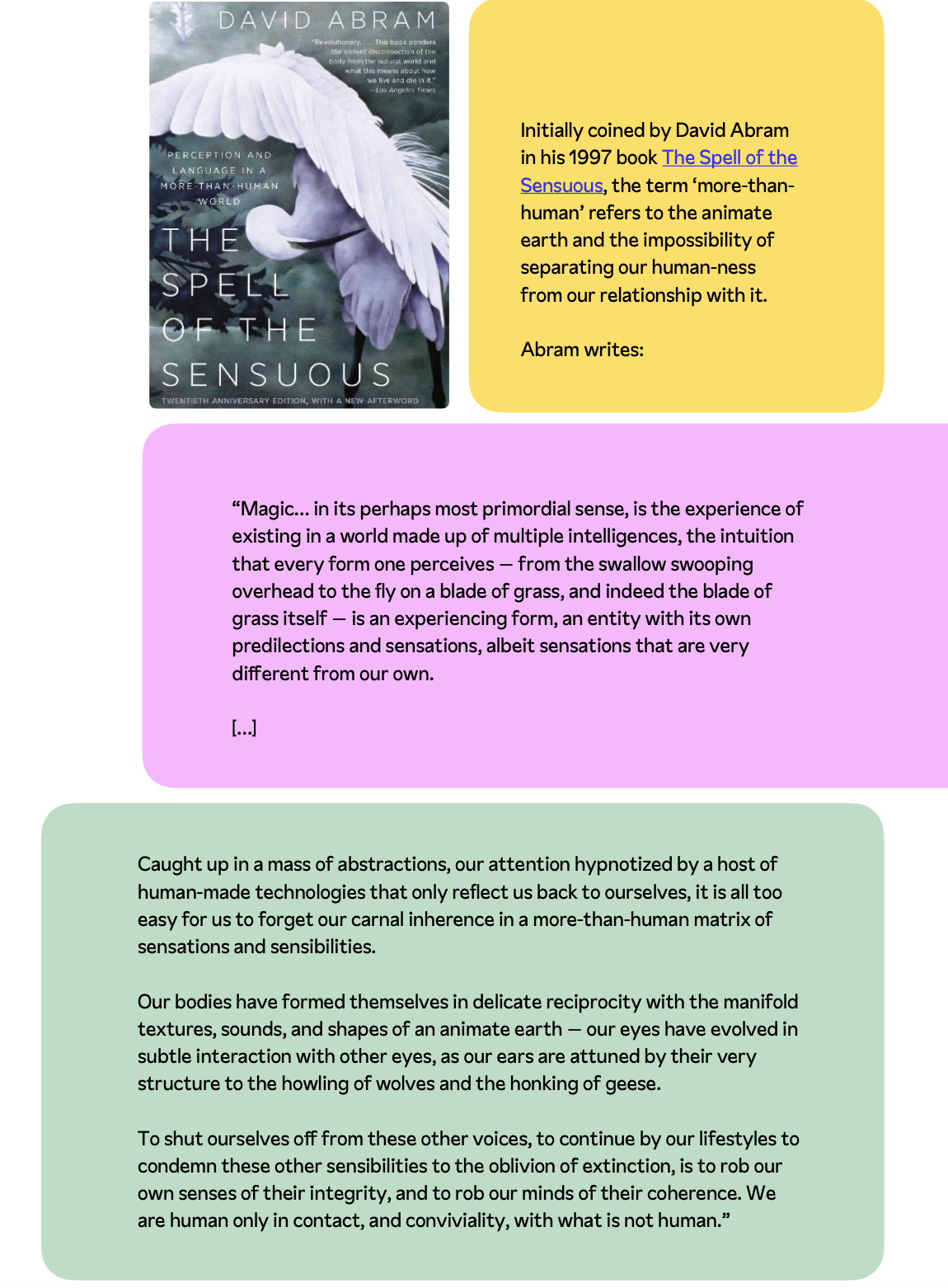
I’ve been working on questions of governance and democracy for well over a decade. It’s only been in the past four years that I would say my own relationship with the natural world has shifted. When, in a moment of personal crisis, I sought solace in the hills and forests. It was around this time that I met my now dear friend and DemNext Board Chair Robbie Stamp, who offered me The Spell of the Sensuous by David Abram, setting me down an intellectual journey. This paper and wider project is part of that path.
For a long time I saw my personal interests and experiences in the mountains as separate from my intellectual work on democracy. It’s only recently I’ve started to see the threads and connections between the two. I had an ‘aha’ moment when someone asked me “Why do you talk about your love of nature so much?” in a professional setting last year, where I realised that I was even doing that. It prompted me to write a first essay on “more-than-human democracy” that flowed out of me.
As I started writing, the connections suddenly seemed obvious. Our relationship with the living world comes forth in questions about belonging, connection, borders, citizenship, time, place, and community. These are all the foundations behind ‘democracy’, upon which our institutions, practices, and rituals get formed. Without a solid foundation, we cannot have a solid democracy.
At a time when there is widespread consensus about ‘democracy in crisis’ all over the globe, going back to the fundamentals about agency, trust, connection, belonging, curiosity, and other relational elements is essential. Expanding that beyond the human-centric lens to recognise we are in relationship not just with each other but with the living world - that we are not separate to it, but a part of it - is equally essential.
Going back to the mountaintop for a moment, when you are straddling what are two different countries, surrounded by nothing but wind, seas of clouds, vulture wakes, and mountain peaks in all directions, you suddenly feel like a very tiny part of this immense planet. It makes me think about borders in new ways. It’s in those moments I feel most grounded and part of something bigger than myself.
What does this mean then for innovations in governance? What would it entail to govern with, not just for, the living world?
The answers to these questions are not obvious to me. People sometimes bring up caricatures like placing a plant at the deliberation table. That is clearly far from the answer! But what is a thoughtful approach to morethan-human governance? What could it mean, in practice, to experiment with such approaches? These are the questions that are at the heart of this initial discussion paper, and are at the heart of DemocracyNext’s project on more-than-human governance.
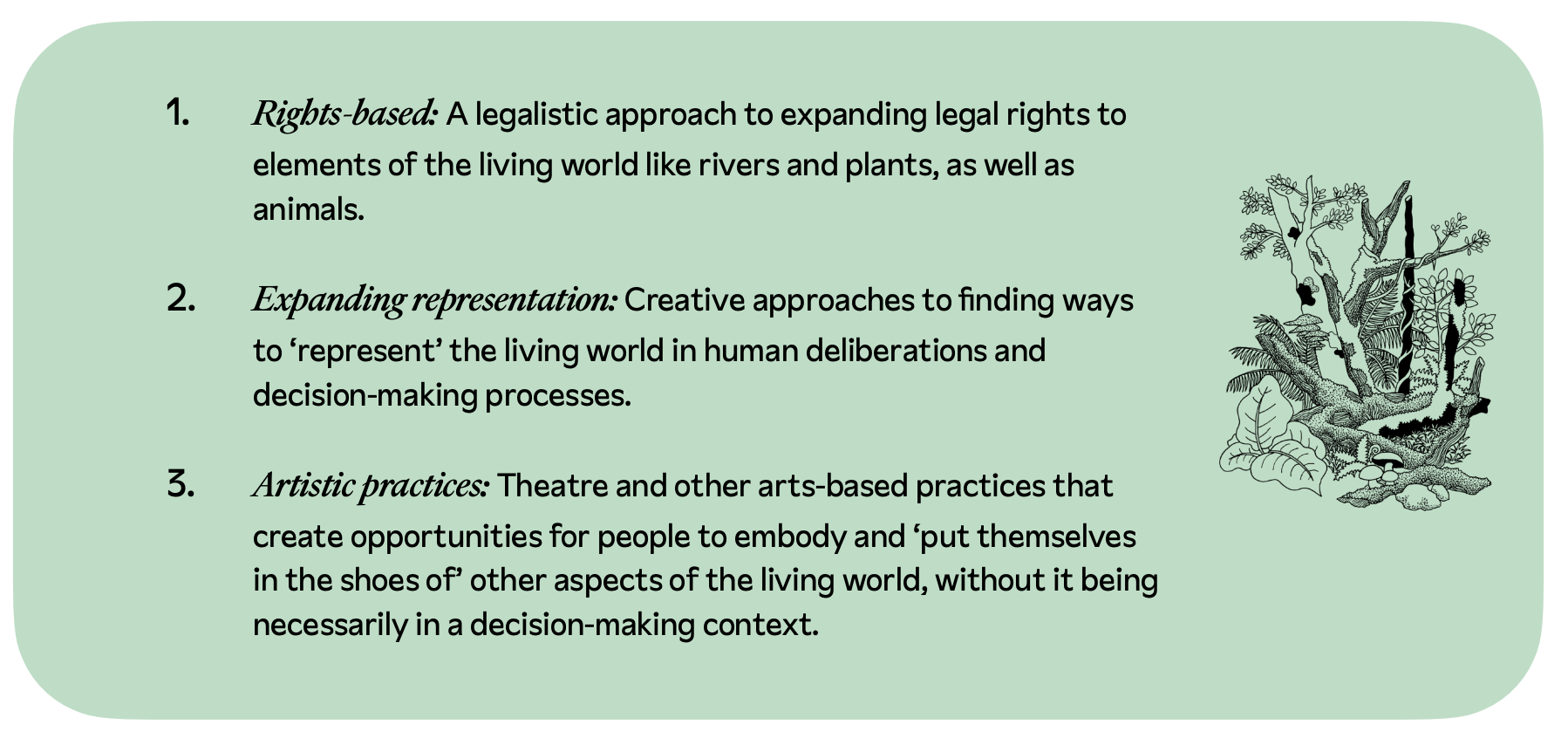
In conducting research on these issues, I’ve interviewed practitioners, lawyers, theorists, designers, artists, and others who are experimenting with different approaches. From interspecies councils to legal approaches that give new rights to elements of the natural world and animals, to artistic practices that create embodied experiences of new governing relationships, and other examples, there has been a richness in imagination about how to approach these questions.
Moreover, while ‘more-than-human’ in the meaning coined by Abram refers to the living world, I am interested in two meanings of ‘more-than-human’ — the other related to technology.
There is a fascinating intersection in the ideas explored here about how new technologies are also enablers of new governance innovations with the living world. For example, the Cetacean Translation Initiative (CETI), a nonprofit, interdisciplinary scientific and conservation initiative has enabled us as humans to listen to and translate the communication of sperm whales. The More-than-Human Rights initiative is exploring the legal implications of this. I think there are also fascinating governance questions that emerge when we consider such technologies becoming more widespread, enabling a wider understanding and communication across species.
This paper and this project are at an exploratory stage. Asking questions. Learning from early experiments. I welcome any additional questions, reflections, responses, and additional examples. My hope is that these explorations lead to some greater clarity about some potential experimentations that we might do at DemocracyNext in the future.
As a next step, together with Arising Quo, DemocracyNext is convening an initial group of people who have been experimenting with more-thanhuman governance approaches in Europe on June 18th for a day-long learning exchange at our headquarters in The Hague. We are certainly learning from and interested in examples globally. However, the focus of our initial project is on Europe as others have documented examples and learnings from other parts of the world more thoroughly.
The examples we have come across are surely not exhaustive. If you are involved in or know of others, please feel free to share them with me and we will add them to this growing database.
How to cite this paper Chwalisz, Claudia (2024), “Governing with the more-than-human world”, DemocracyNext.

Abram’s work draws on a mix of history of language, phenomenology - a branch of philosophy concerned with understanding the world through physical life experiences, indigenous wisdoms, biology, and other branches of the sciences and humanities. A multi-disciplinary foray into examining our ways of being in the world, the book has had a profound intellectual and emotional impact on my own life and on my reflections about governance and democracy.
Since reading The Spell of the Sensuous, the section of my personal library that could be simply described as ‘nature writing’ – though is in fact a wide range of books touching on biology, neuroscience, history, philosophy, and other disciplines – has exploded.
The divisions between it and my books on democracy are ever harder to distinguish, as the connections between the themes that emerge are impossible to disentangle. As I wrote in an essay at the end of last year, our relationship with the living world comes forth in questions about belonging, connection, borders, citizenship, time, place, and community – the fundamental elements of democracy.
Often geo-politics, wars and security concerns dominate the headlines as the ‘real issues,’, while our relationship with the more-than-human world is seen as less ‘serious’—almost as if it is optional. Yet in my view it would be a mistake to think that.
Through her experiences in Ireland and Northern Ireland, Kerri ni Dochartaigh makes a strong case in Thin Places for why we cannot separate questions of war and security from considerations about our relationship with the natural world. She talks about her experience of growing up in Derry during the Troubles:
"When whole streets are burned down, and the fact of a city changed beyond recognition, very few folks notice their disconnect with the natural world. When you’ve no home to go to because it’s been petrol bombed, seeking the wonder of the wild world is not a priority."
But, she also goes on to articulate precisely why reconnecting with the natural world can be so healing and so powerful, drawing on her own experience of how it helped her get over her thoughts of suicide:
"There is so much life in the places around us and, sometimes, for some of us, somehow, this helps us to value our own life… Battles, governments, laws, leaders - borders - come and go, but the land and its sacred places remain unmoved and unchanged in their core."
A disconnection from the natural world is one part of the myriad reasons why many people feel disconnected from each other, feeling alone and depressed and powerless. These are precisely the emotions that autocrats feed upon, enflaming them to entrench divides and to gain their own strength.
Research finds that those who feel more connected to nature also tend to feel more connected to humanity. The UNDP has also argued that there is a critical connection between human rights and the natural world. We have evidence from numerous studies that time spent in nature and practices like ‘forest bathing’ have noticeable impacts on people’s nervous systems, making them calmer and happier. Other research supports the positive impacts on the well-being and behavioural development of children who spend more time in green spaces.
I am reminded of another passage in Abram’s book:
"For at the very moment that human populations on every continent have come to recognize the planet as a unified whole, we discover that so many other species are rapidly dwindling and vanishing, that the rivers are choking from industrial wastes, that the sky itself is wounded. At the very moment that the idea of human equality has finally spread, via the printed word or the electronic media, into every nation, it becomes apparent that it is indeed nothing more than an idea, that in some of the most ‘developed’ of nations humans are nevertheless destroying each other, physically and emotionally, in unprecedented numbers – whether through warfare, through the callousness of corporate greed, or through a rapidly spreading indifference.
Clearly, something is terribly missing, some essential ingredient has been neglected, some necessary aspect of life has been dangerously overlooked, set aside, or simply forgotten in the rush toward a common world. In order to obtain the astonishing and unifying image of the whole earth whirling in the darkness of space, humans it would seem, have had to relinquish something just as valuable – the humility and grace that comes from being fully a part of that whirling world. We have forgotten the poise that comes from living in storied relation and reciprocity with the myriad things, the myriad beings, that perceptually surround us.
Only if we can renew that reciprocity – grounding our newfound capacity for literate abstraction in those older, oral forms of experience – only then will the abstract intellect find its real value. It is surely not a matter of ‘going back,’ but rather of coming full circle, uniting our capacity for cool reason with those more sensorial and mimetic ways of knowing, letting the vision of a common world root itself in our direct, participatory engagement with the local and the particular."
While writing in 1997, Abram’s words resonate more than ever today. We are seemingly more ‘developed’ and ‘advanced’ than ever. Yet humans are still tearing each other apart, new wars are entrenching old divides ever deeper, and we are facing multiple human challenges — rates of loneliness, depression, suicide, and other symptoms of disconnection have been increasing over the past few decades.
It’s clear that many people do not feel like they are living in “storied relation and reciprocity” with the myriad beings that surround us. I think that Abram is right in emphasising that this is not about “going back” to anything. Rather, “coming full circle” is a useful metaphor for thinking about how we could gain another sense of knowing ourselves and the world by reconnecting, in a very physical way, with the natural world around us.
We should also be thinking about how to inspire reconnection with the world in a joyful way. Much of the current narrative is negative and catastrophic, about climate crisis, extinctions, and similar. However, I agree with Michael McCarthy, who writes in The Moth Snowstorm: Nature and Joy, that:
“We should offer up what [nature] means to our spirits; the love of it. We should offer up its joy…. Firstly, because the mortal threat itself is not centuries old, but has arisen merely in the space of my own lifetime; and secondly, because the joy nature gives us cannot be quantified in a generalised way… we have infinitely different longings for solace and understanding and delight… Defence through joy, if you like. For nature, as human society takes its wrecking ball to the planet, has never needed more defending.”
For the sake of the future of humanity and the future of the planet, we need to find new ways of living and governing together. Part of the problem that we face today is people not being truly present, and we need to take action now for the reality we want to be living in today.
As Abram writes:
“A genuinely ecological approach does not work to attain a mentally envisioned future, but strives to enter, ever more deeply, into the sensorial present. It strives to become ever more awake to the other lives, the other forms of sentience and sensibility that surround us in the open field of the present moment.”
By ‘ecological’ he is not talking about the political movement that has become associated with these ideas. The term ‘ecology’ was initially coined in the mid-19th century by the German naturalist Ernst Haeckel in his book Generelle Morphologie der Organismen (General Morphology of Organisms). He wrote, “by ecology, we mean the whole science of the relations of the organism to the environment including, in the broad sense, all the conditions of existence.” The word derives from the Greek word for ‘house’ or ‘environment’, ekos, and in a footnote Haeckel also referenced the Greek word for ‘dwelling place’, hora. As James Bridle reminds us in Ways of Being, Haeckel was deeply inspired by Darwin’s work, especially in the relationships between species.
Bridle writes:
“Ecology is the study of interrelationships: those unbreakable cords which tie everything to everyone else. Crucially, those relationships extend to things as well as beings: ecology is just as interested in how the availability of nesting materials affects bird populations, or how urban planning shapes the spread of diseases, as it is in how honeybees pollinate marigolds and cleaner wrasses delouse surgeonfish. And that’s just biological ecology. Ecology is fundamentally different to the other sciences in that it describes a scope and an attitude of study, rather than a field. There is an ecology - and ecologists - of mathematics, behaviour, economics, physics, history, art, psychology, warfare, and almost any other discipline that you can think of.”
Taking the ecological approach to democracy, in my view, is about exploring the full depth and complexity of the interrelationships that we have between people, the living world, and technology.
Democracy has evolved in different ways in different parts of the world at different moments of history. Democracy involves a mix of institutions, practices, rules, spaces, and rituals.
How do we want democracy to evolve today, and what perspective do we want underpinning how we think about it?
For me a recognition of the interconnectedness of all things is essential for trying to understand the world, and should be taken into account in how we innovate all aspects of democracy.
Most of our current democratic institutions, practices, rules, spaces, and rituals are not designed or implemented to reflect our interrelationships in the world. They also of course differ from region to region and country to country, so in many ways it is also unhelpful to talk about them as though there is a wider uniformity.
Zooming in on Europe as the focus of this specific research study, we can say that today most European countries’ democratic systems are defined by systems of elections and rule-of-law that is human rights-centric, with parliamentary procedures and spaces, fairly strong and often independent public administrations, and systems favouring debate and voting practices. All of these elements fall on a spectrum, and there is of course variation between countries.
How to evolve and innovate such governance systems in a way that brings in more-than-human elements? We have identified a growing number of examples across Europe that are doing so in different ways. The three main approaches as I have come to understand them are: