"I am thrilled to announce that Vilnius is set to host its very first Citizens' Assembly on urban development! This is a momentous occasion for our city as we embark on a journey to engage our community in shaping the future of our urban spaces. Citizens' Assemblies are participatory forums where a diverse group of residents come together to deliberate and provide input on key issues, ensuring a wide range of perspectives are considered in the decision-making process." - Laura Kairienė, Chief Architect of Vilnius City Municipality
To learn more about the assembly, and stay up to date on the activities, visit the dedicated assembly website. You can also learn more about how the assembly process works with this short explainer video:
The assembly was initiated and led by Beatričė Umbrasaitė (advisor to the Chief City Architect), Laura Kairienė (Chief City Architect), and Gabrielė Janilionytė (Lead facilitator). It is also supported by both the mayor and deputy mayor of Vilnius City Municipality and the city’s transportation department JUDU (“You Move” in English).
The municipality of Vilnius decided that the assembly should address the following question:
How can we ensure that Vilnius residents more often choose public transport, walk, or cycle – regardless of where in the city they live?
In Vilnius, motor transport accounts for the largest share of all greenhouse gas (GHG) emissions in the city – as much as 38% (according to JUDU data). One of the main challenges for Vilnius's air quality, and consequently for the health of people and nature, is the transport sector.
Vilnius already has a plan to make movement in the city more convenient, safer, and environmentally friendly by 2030. This is defined by the Vilnius Sustainable Mobility Plan 2030, approved in 2018. According to this plan, by 2030, only 30% of daily trips in Vilnius should be made by car, and the rest by public transport, on foot, by bicycle, or scooter. However, the number of daily trips made by car in Vilnius reached 49% in 2024.
The citizens' assembly offered an opportunity for everyone – not just politicians or experts – to decide together how Vilnius can achieve its climate-neutrality goals while creating a city that is accessible to everyone, no matter where they live.

In Lithuania, participatory budgeting is quite a popular citizen participation method, as well as public consultations and town hall meetings. But more advanced engagement methods, like deliberative processes, haven't been implemented yet. Lithuania is now catching up with its neighbours in the region, who have been implementing assemblies since 2016.
Since 2019 Vilnius municipality has been testing various forms of citizen participation in urban planning. The most recent examples have involved process-driven participation sprints to create visions and guidelines for change in public spaces. These sprints may last from 2 months to 1 year involving online and street surveys, creative workshops, pop-up project discussions, street festivals, and so on. Some of these include:
October 2024 - January 2025: All cities in the cohort followed a nine-module citizens' assembly learning programme to build their knowledge and capacity to deliver an assembly in their context.
February 2025: DemocracyNext hosted a design workshop to refine the structure and purpose of the assembly. Meetings were held with politicians and civil servants who will be involved in the process.
March 2025: We Do Democracy hosted a deliberation facilitation training, bringing together 30 practitioners from across Europe.
May – July 2025: The oversight panel, composed of local experts, met five times to advise on the design of the assembly, draft the information packet, and select expert presenters for the assembly.
August 2025: 13,000 random invitations were sent to citizens of Vilnius, launching the sortition stage of the assembly. The final selection took place using Panelot, and assembly members were notified in early September.
September – November 2025: The Vilnius citizens’ assembly met across a series of weeknight and weekend sessions.
December 2025: The assembly’s recommendations were presented to the Mayor of Vilnius and the Transportation Department (you can watch the recorded handover below).
Early 2026: An evaluation report on the assembly will be published.
January 2026: Recommendations reviewed by Vilnius City Municipality; implementation plan prepared.
February-March 2026: Implementation plan shared with relevant departments, municipal companies, and the public.
March 2026 (3 months post-assembly): Report on recommendation implementation, including public summary and presentation.
December 2026 (1 year post-assembly): Progress report assessing recommendation usage, reviewing early impact signs, and providing insights for further action.
Invites: 13,000 invites were sent at random to residents of Vilnius
Number of positive responses: 731 (6% response rate)
Demographic criteria: Gender, age, nationality, neighborhood, socio-economic background, preferred mode of transport. Invitations were not limited to Lithuanian citizens but assembly members needed to be residents of Vilnius.
Assembly member selection: 54 citizens were randomly selected through a stratified random selection to mirror the demographics of Vilnius. Each was contacted by phone, and 43 agreed to participate. Ultimately, 39 citizens took part in the assembly.
Assembly duration: The assembly met 7 times between 24 September - 10 December 2025 for a total of 45 hours
Facilitation: Gabrielė Janilionytė (Lead facilitator), Ugne Balciunaite, Rūta Lukošiūnaitė, Nikita Ščiupakov, and Emilija Blaškevičiūtė.
Onboarding evening - 24 September 2025
The first session took place on a Wednesday evening to kick off the process, allowing assembly members to get to know one another and hear from the Chief City Architect as well as the organising team and facilitators. They were introduced to the assembly process, how it would work and why their contributions were both needed and highly valuable to the municipality.
Session 1 - 27 September 2025
During the first session, assembly members spent time getting to know each other in plenary and in small groups. They were introduced to the facilitation team, the evaluators, volunteers, and organisers. They also learned more about the goals of the assembly then started learning about the assembly topic from JUDU Vilnius’ mobility department. They were introduced to the city’s Sustainable Mobility Plan and heard from 5 commentators (transportation engineers, urbanists, academics). These included:
Session 2 - 4 October 2025
Assembly members spent a full day visiting Vilnius’ Railway Museum and the "Smoke Factory," hearing presentations from eight community representatives. This included:
Between the morning and afternoon sessions, assembly members traveled by train to Naujoji Vilnia, a practical experience in sustainable mobility that allowed them to ride the local rail transport as part of the public transport system.
After the presentations, a question-and-answer session took place, during which participants, together with experts and representatives of civil society organizations, discussed the key challenges that had been identified. Assembly members continued filling in the “Challenges and Changes” sheets, recording the ideas and insights they had heard.
This was followed by the interactive game of “Bingo,” the aim of which was to visualize a shared map of how challenges and changes are perceived and to identify gaps in the insights.
The second session ended with short films from the International Cycling Film Festival, which creatively explored different transportation modes and their urban role, encouraging participants to reflect on mobility culture from a new perspective.
Session 3 - 18 October 2025
The third session marked a shift from analyzing mobility challenges to developing concrete solutions that would encourage residents to choose public transport, walking, or cycling more often.
JUDU presented Vilnius's 2050 mobility vision, covering:
Assembly members then worked in small groups to develop mobility visions for each of the five categories.
Based on these visions and information gathered in previous sessions, assembly members began drafting initial recommendations. Groups formulated specific problem definitions, possible solutions, and the expected impacts on residents.
Session 4 - 8 November 2025
The fourth session focused on systematically refining and evaluating the 67 draft recommendations from Session 3.
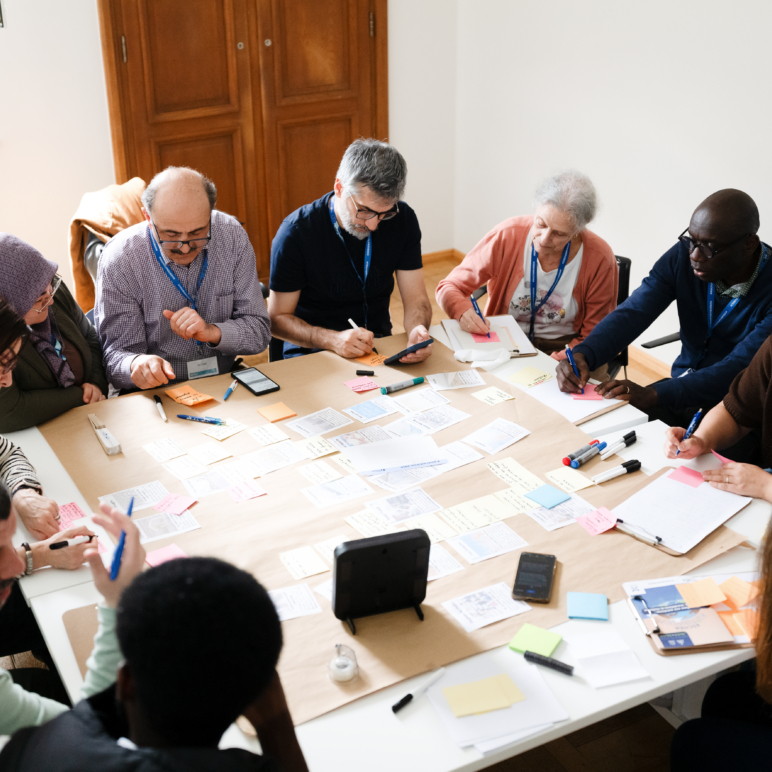
Assembly members worked through a structured review process, first individually, then in pairs to identify themes and overlaps, and finally in groups of three to resolve ambiguities and strengthen recommendations.
Traffic light assessment
Recommendations were categorised by consensus level:
Assembly members then refined the wording and structure of recommendations with facilitator support, concluding with a collective review of all "green" recommendations to confirm readiness for the final stage.
Session 5 - 29 November 2025
The fifth session focused on formulating and voting on final recommendations. The goal was to ensure all recommendations were clear, logical, well-reasoned, and based on consensus.
Before this session, assembly members received written feedback on each of the draft recommendations from a working group of municipal staff working across various departments.
The feedback group met twice, each session was 2h long. First meeting was November 12th, second - November 17th
The group was composed of municipal department managers whose work aligns with the recommendation topics. The group included the chief architect and her advisors, the JUDU Strategic Department, the Chief City Sustainability Officer, the Infrastructure Department, Environment Department, and the Strategic Department.
They were asked to give feedback on:
Assembly members worked in small groups of 5-6 people to refine recommendations based on feedback from the municipality, strengthening their argumentation and structure. The revised recommendations were compiled into a single digital document for collective review, allowing assembly members to assess the overall results and ensure quality and consensus before voting.
Final evaluation: Three-colour card method
Assembly members evaluated each recommendation using coloured cards:
For yellow cards, the group sought minimal corrections to reach consensus.
Voting process
The final recommendations were approved through anonymous voting using the digital platform, Slido, to ensure participants could express their opinions freely without peer pressure. Participants voted by using their smart phones, while those without smartphones used computers. Results were displayed immediately on a large screen at the front of the room for everyone to see.
A recommendation was adopted if it received at least 70% support from assembly members who voted. This consensus threshold, rather than a simple majority, ensured recommendations reflected broad agreement among participants.
Abstention was not counted in the support percentage, meaning the percentage reflects only those who voted "FOR" versus "AGAINST" each recommendation.
Session 6 - 10 December 2025
On December 10 2025, assembly members presented their final recommendations to Vilnius City Vice Mayor Andrius Grigoronis, symbolically concluding the assembly process.
During the ceremony, assembly members reviewed the assembly's progress, highlighted key challenges and achievements, and presented the main directions of their recommendations for improving urban mobility. The Vice Mayor thanked assembly members for their active involvement and responsibility, emphasizing that the recommendations would provide significant insight for municipal decision-making.
The ceremony marked an important step in strengthening resident involvement in city policy formation.
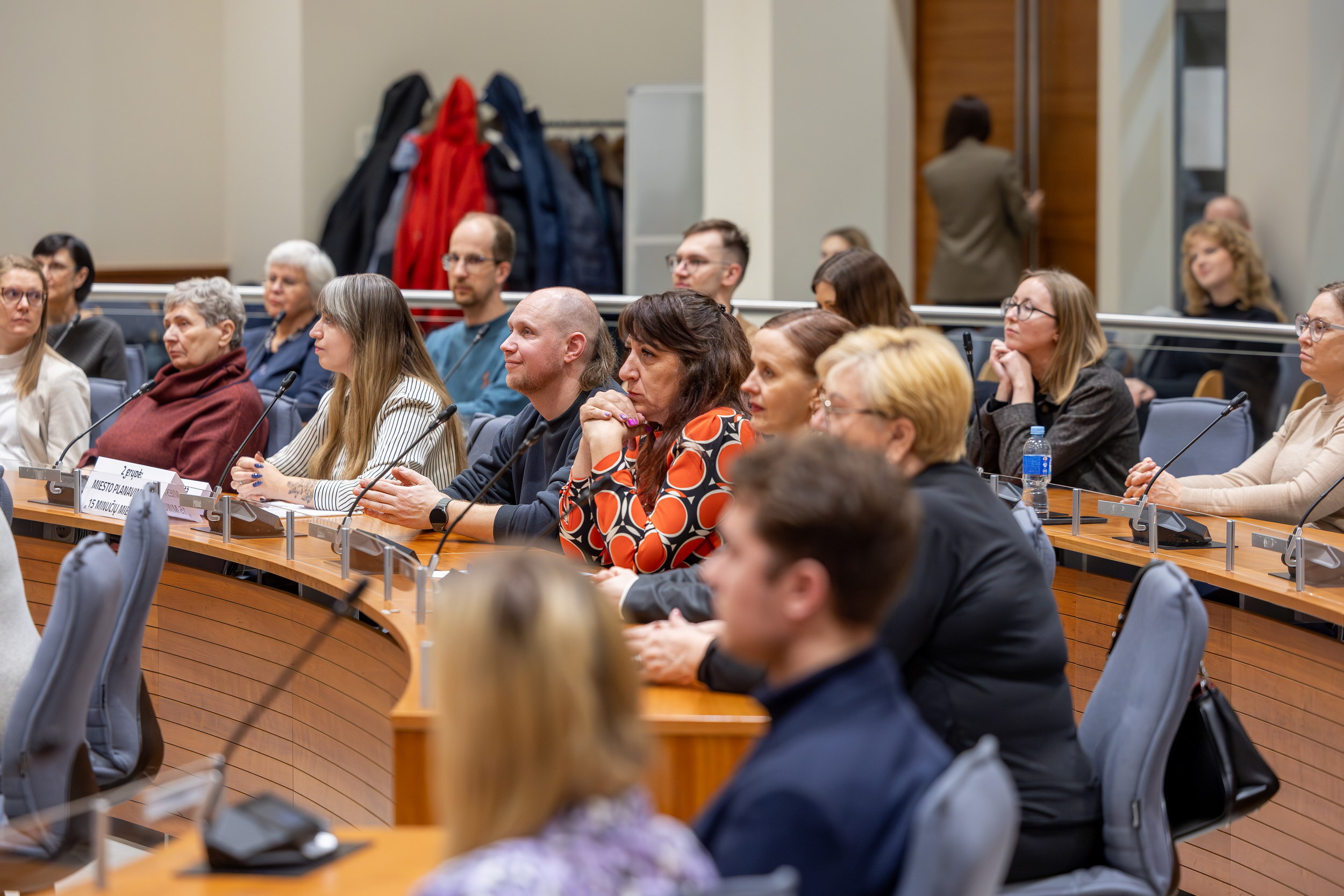
As two assembly members were more comfortable speaking Polish and Ukrainian than Lithuanian, facilitators ensured they could participate fully and seamlessly in the process. Both were provided with translators who live-translated presentations and assisted them in small-group discussions.
Assembly members were also paid for their time. Each member was paid 250 euros in compensation in three instalments.
How will the municipality implement the recommendations?
The recommendations will inform municipal decisions on mobility challenges, drawing on residents' experience, arguments, and consensus. Municipal departments and institutions will assess recommendations according to their competencies, analysing feasibility, potential impact, and alignment with city strategic documents and existing measures. JUDU and Vilnius’ Strategic Planning Division are committed to systematically integrating recommendations into planning, budgeting, and implementation processes where possible.
Review and decision-making process
Monitoring implementation
To ensure transparency and public accountability, two monitoring reports will be published:
This monitoring process ensures the citizens' assembly is not a one-off project, but an ongoing democratic dialogue that strengthens resident trust and sets a precedent for future assemblies in Vilnius.
The municipality communicated widely about the assembly. They placed posters around the city to announce the process, posted on social media, and organised interviews with key people in the core team on local radio and in the media.
The journalist collective NARA followed the assembly closely, observing the assembly, interviewing organisers, representatives from the municipality, and assembly members.
A short documentary about the assembly has been produced by local film maker Deividas Autukas and will be made available in late March 2026.
The assembly is being evaluated by Ieva Petronytė-Urbonavičienė and Rasa Bortkevičiūtė from the Institute of International Relations and Political Science at Vilnius University. Their evaluation covers core elements of the assembly process in order to learn from this first experience to improve on the design of future assemblies in Vilnius and across Lithuania. The evaluation used mixed methods (document analysis, interviews, surveys) and follows participants' journeys from before the assembly through six months after, in order to capture both immediate reactions and longer-term impacts. Specifically it will look at:
The evaluation will assess impact on multiple stakeholder groups:
The municipality has expressed interest in institutionalising this model of citizen deliberation to address other key challenges in the city. In December 2025, DemocracyNext facilitated a workshop with the Head of Vilnius’ Strategic Planning Division, advisors to the Chief City Architect, as well as organisers and facilitators of the assembly to explore steps towards institutionalisation. Some ideas that emerged included:
The evaluation prepared by Vilnius University will also provide further guidance on how deliberative democracy practices could be integrated into decision-making processes in Vilnius.
By the end of January 2026: Vilnius’ Strategic Department will analyse each recommendation and propose how they can be implemented: connecting them to strategic documents, budgets, timing and the responsible departments or municipal organization. This will serve as an implementation plan for the recommendations. This will be confirmed by the Vice Mayor.
March 2026: The implementation plan will be presented to relevant stakeholders and published publicly.
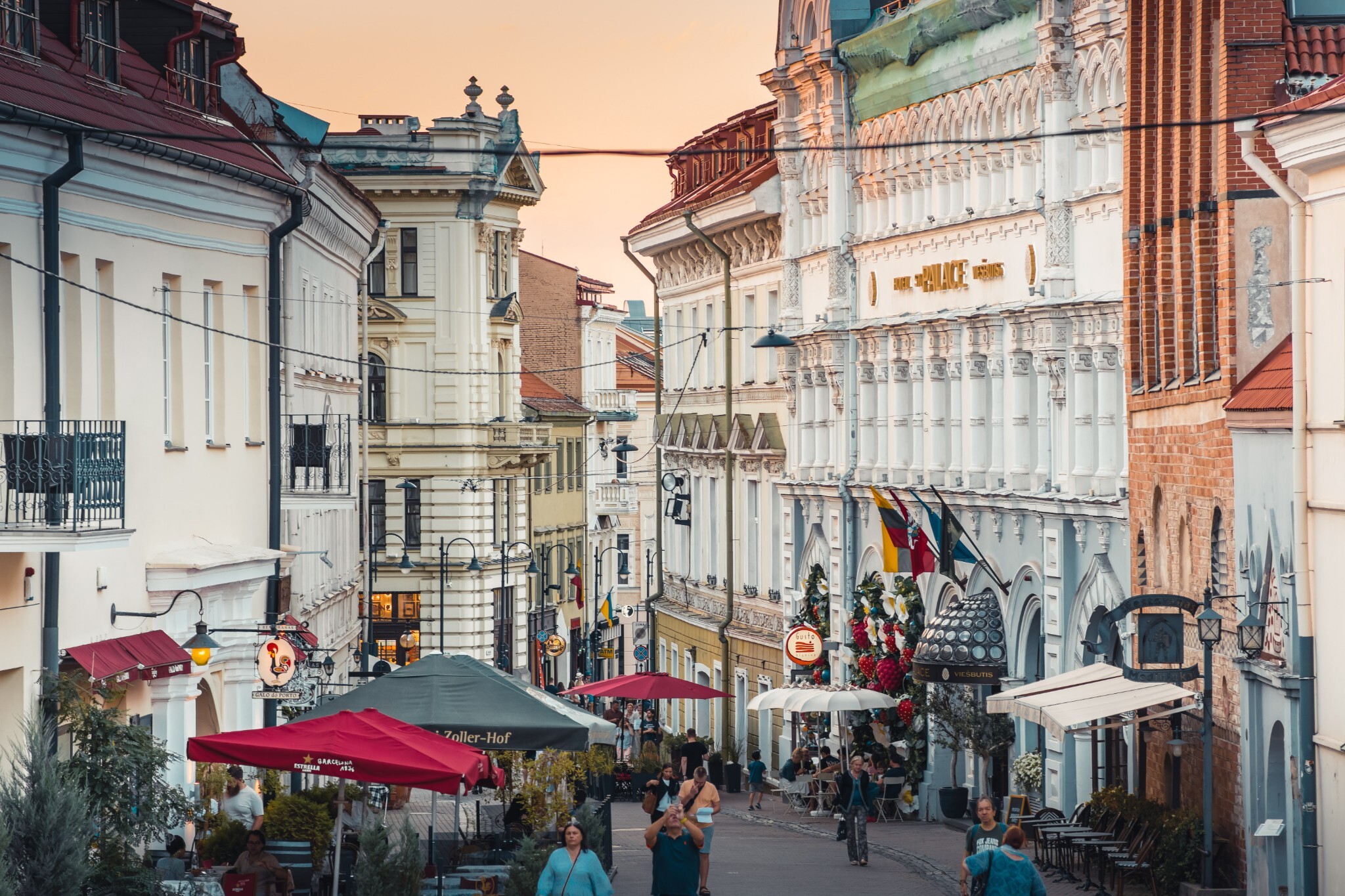
With a population of over 600.000 and the capital of Lithuania, Vilnius serves as the political, cultural, and economic heart of the country. The city has a rich history, with its origins dating back to the early 14th century, as the centre of the Grand Duchy of Lithuania. Historically, Vilnius has been a melting pot of various cultures and ethnicities, including Lithuanian, Ukrainian, Polish, Jewish, Russian, and Belarusian communities.
Today, the city features one of the largest and best-preserved medieval old towns in Europe, recognised as a UNESCO World Heritage Site. It has also become a hub for digital nomads in recent years, with areas like the New City Center having transformed into bustling business districts with modern skyscrapers, while neighbourhoods like Užupis offer charm with its unique cultural and historical identity. Overall, Vilnius is characterised by its blend of historical significance and contemporary urban life.
Vilnius, like many other post-Soviet-era cities, also faces the challenge of transforming its infrastructure to meet the needs of a growing, 21st century European capital city. Mobility has been an increasingly contentious topic in Vilnius. Reducing car-dependence to tackle greenhouse emissions while ensuring equal access to multiple mobility options in every part of the city is something the municipality is struggling with. This is why it is turning to its citizens to find a way forward.
Make sure to check back here for updates as we continue this collaboration with Vilnius.
← Back to Cities Programme