In this paper, we outline why we need a European Citizens’ Assembly — a political institution of everyday people from across the European Union (EU) selected by sortition — why it should share real power with the other institutions of the EU, its core principles and design features, and we suggest pathways for implementation.
How to cite this paper: Berg, Carsten, Claudia Chwalisz, Kalypso Nicolaidis, and Yves Sintomer (2023), “The European Citizens’ Assembly: Designing the missing branch of the EU”, European University Institute and DemocracyNext.
Free to share under CC BY-NC-ND 4.0 - see our sharing policy.
In this paper, we outline why we need a European Citizens’ Assembly — a political institution of everyday people from across the European Union (EU) selected by sortition — why it should share real power with the other institutions of the EU, its core principles and design features, and we suggest pathways for implementation.
Three sets of questions for design variations:
Initiation: Multiple triggers
Authorship: Variable configurations
Decision making: Impact, authority, and accountability
How do we get there?
The process of establishing the EUCA will be iterative and dynamic.
The EU Citizens’ Assembly could be legally created in various ways: by a joint decision or inter-institutional agreement between the three existing EU institutions, by a Convention revising the treaties, by an EU referendum, or even as a result of an empowered EU Citizens’ Initiative.
We need the momentum and inspiration provided by a more radical horizon. We need both citizen empowerment by EU institutions and the kind of self-empowerment by citizens alongside civil society.
In a broader context of democratic crisis and green, digital, and geopolitical transitions, we need to open up our imaginations to radical political change. Political and technocratic elites must start giving up some control and allow for a modicum of self-determination by citizens.
How to cite this paper: Carsten Berg, Claudia Chwalisz, Kalypso Nicolaidis, and Yves Sintomer (2023), “The European Citizens’ Assembly: Designing the missing branch of the EU”, European University Institute and DemocracyNext.
Early ideas in this paper were discussed at a workshop hosted at the EUI in Florence in September 2022. We would like to thank the workshop participants for their inputs, as well as our colleagues for their feedback on the final draft: Luca Belgiorno-Nettis (newDemocracy Foundation), Paulus Albertus Blokker (University of Bologna), Ieva Cesnulaityte (DemocracyNext), Yves Dejaeghere (Federation for Innovation in Democracy - Europe), Michele Fiorillo (Citizens Take Over Europe), Andrea Gaiba (EUI), Nathan Gardels (Berggruen Institute), Ingrid Godkin (European Commission), Ulrike Liebert (EUI), James Mackay (EUI), Niccolo Milanese (European Alternatives), Dawn Nakagawa (Berggruen Institute), Lucy Reid (DemocracyNext), Colin Scicluna (European Commission), Toma Sutic (European Commission), David Van Reybrouck (G1000), and Iain Walker (newDemocracy Foundation).
Introduction
We offer here a rationale and a design for the European Citizens’ Assembly (EUCA, Assembly in shorthand) — a political institution that shares power with the other institutions of the EU, notably the European Council, Commission, and Parliament. This design is meant to serve as one of the beacons for the ‘Democratic Odyssey’ and its constituent network as it designs and convenes a prototype European Citizens’ Assembly.
The EUCA encapsulates a network of Citizens’ Assemblies as new democratic institutions throughout the EU, coming together around a standing body with Members selected by lottery at different levels of government, interconnected with one another as well as with the other EU institutions.
Why is this needed? Our rationale for such a project stems from the exploration of the great question of our time: what kind of democratic renewal can help deliver the existential transitions we are facing — green, social, digital, and geopolitical. In this story, the European Union has a crucial role to play both as a laboratory (but certainly not the only one) and as an actor in its own right. At a time of systemic contestation of the worth of democracy itself, and of its very definition, the stakes could not be higher. If citizens do not have genuine agency and voice in deciding the big issues facing us in this age of turbulence, our entire political system could break down and we will have lost the battle in defence of democracy.
We believe that the time has come to make a significant step forward, to move the needle on the EU’s democratic paradigm and open up a path for EU institutions to give people genuine voice and power in shaping EU-level decisions. The EU Citizens’ Assembly can do that in three ways:
Horizontally: By connecting everyday European citizens (in the broad, civic meaning of the term rather than the narrow definition limited to the passport one holds) directly to one another, and not only through their respective governments and bureaucracies, or EU institutions.
Bottom-up and top-down: How this happens cannot simply be top-down, through mandates decided by those in charge and connected to the realm of traditional electoral democracy, but needs to evolve organically from bottom-up initiatives too, including political movements, unions, civil society organisations, and active citizens.
With permanence: Only a standing Assembly could avoid arbitrariness and cherry-picking on when and how such Assemblies are convened, while at the same time opening up the promise for learning over time and acquiring a status understood by the citizenry. The ongoing nature of the Assembly’s existence will be combined with intermittence through rotating membership (of a few months), a feature which has nearly always characterised bodies selected by lottery in democratic and republican history.
The good news is the foundations for the EUCA have already been laid. Many citizens across Europe are engaged in democratic innovations at the local, regional, and national levels, including in the form of Citizens’ Assemblies with Members selected by lottery with stratification (sortition). At EU level, the Conference on the Future of Europe (CoFE, 2021-2022) has opened a window of opportunity by offering a fascinating experiment with its four Citizens’ Panels that each brought together 200 people selected by lottery from across 27 Member States to deliberate in 24 languages for around six days. The European Commission has since continued commissioning Citizens’ Panels to inform its policy making processes in 2022-2023.
Here we propose basic principles, together with a sketch of what the EU Citizens’ Assembly could look like. But the specifics are open-ended, as we hope and believe that they will be up to the democratic imagination of the citizens themselves who will appropriate and modify them.
1: Why do we need the EU Citizens’ Assembly?
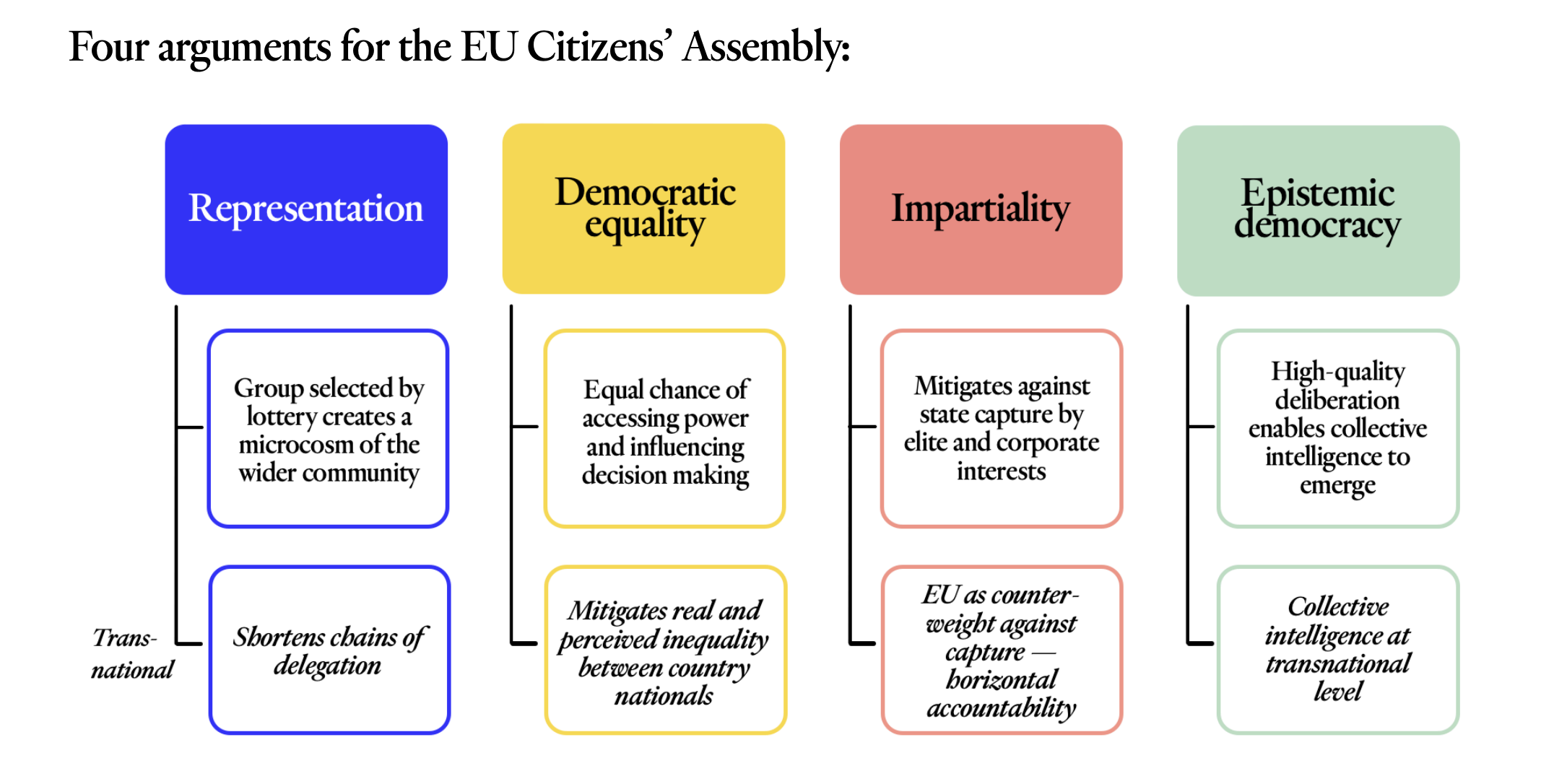
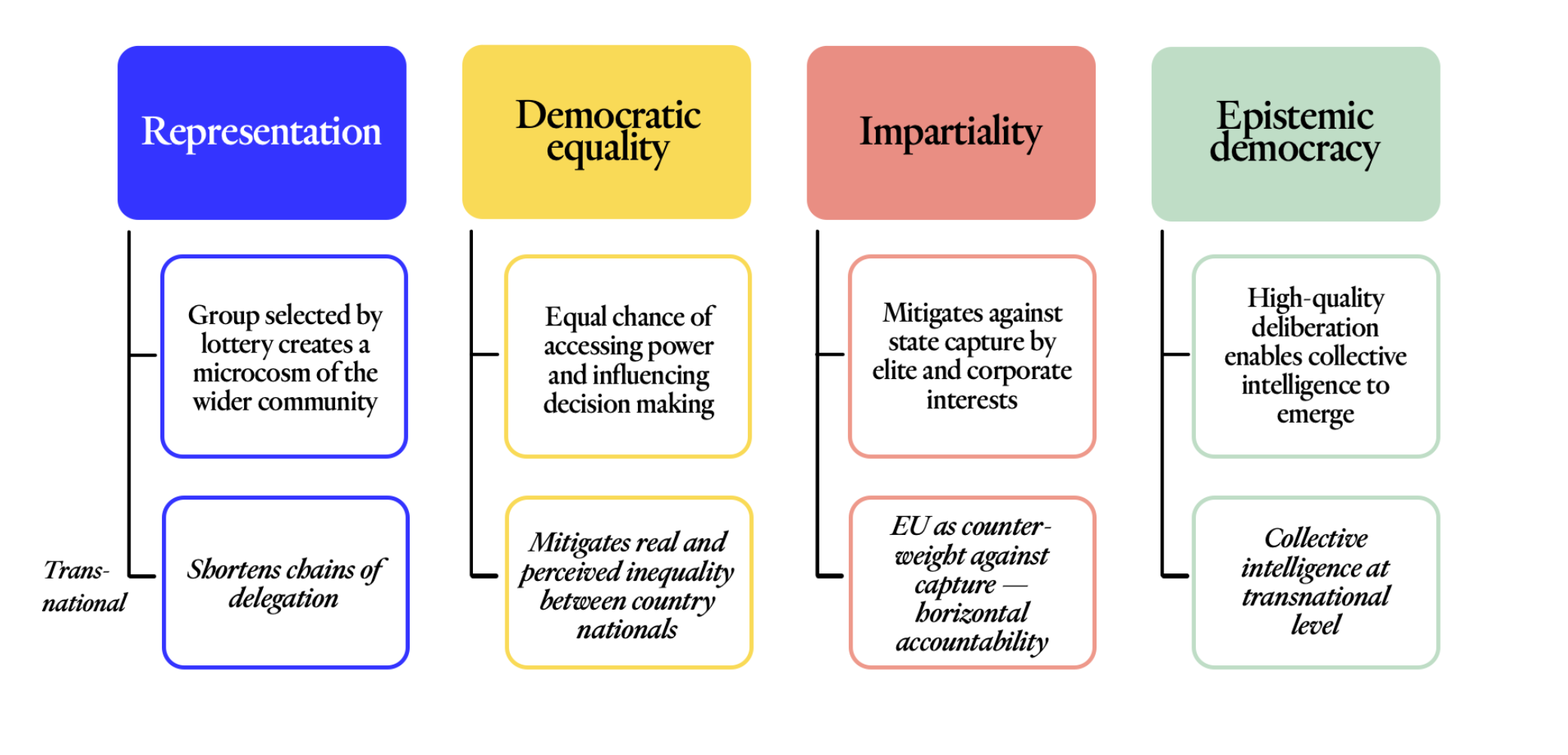
The rationale for re-introducing Assemblies with Members selected by lottery in politics has been demonstrated at length both in theory and practice. Four arguments are commonly put forward for sortition. We consider how they scale up to the EU level, as there are, in fact, good reasons to think that these arguments are as relevant in the EU as elsewhere, perhaps even more so given its transnational character as a ‘demoicracy’, meaning a union of peoples who govern together but not as one.
Representation
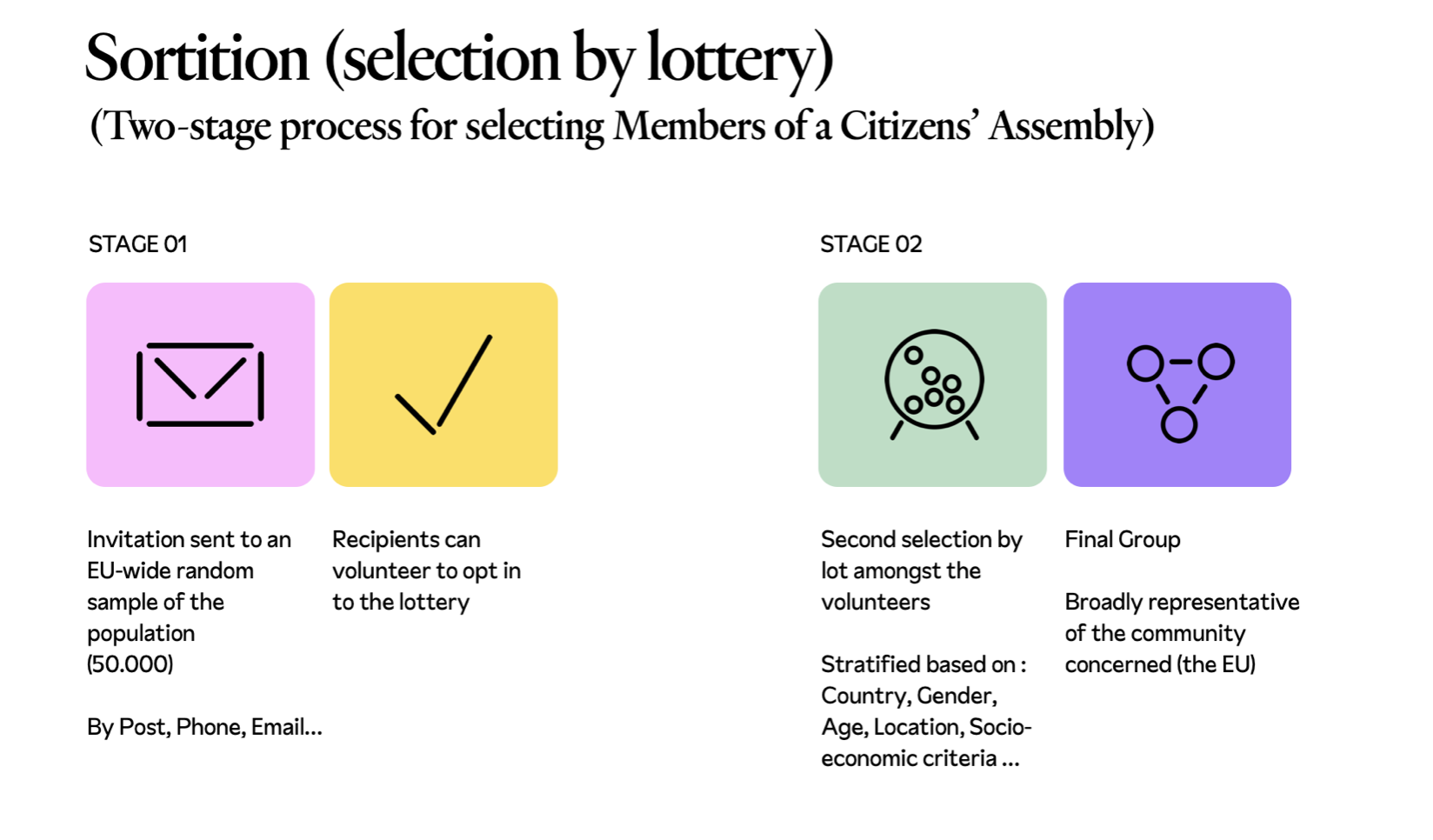
Such as it is practised today, sortition usually involves two stages. In a first stage, a lottery takes place to invite people to be Assembly Members from a pool of randomly drawn citizens. In a second stage, amongst everybody who responds positively to this first invitation, there is a process of “stratification” to ensure broad representativeness of the community, following the techniques developed for opinion polls: the organisers first define quotas by gender, age, regions, education, income, race, sometimes behavioural attitudes, to which other criteria can be added. The final group making up a Citizens’ Assembly are therefore selected by lottery amongst everybody who responded positively to the initial invitation, ensuring broad representativeness along the criteria identified.
Figure 1: Sortition process for the EU Citizens’ Assembly.
This allows for the constitution of a broadly representative and diverse cross-section of everyday people. It is a different kind of representation than elections, which tend to select individuals from the upper and middle classes of society. Other kinds of “pools” can be added such as towns, cities, and regions or non-EU migrants or participants from the rest of the world.
But can a few hundred citizens selected by lottery ‘represent’ 500 million citizens across 27 or more countries? They can, to the extent that both their selection and the debates they conduct are communicated with the broader public in a way that is radically transparent. Let’s compare with what we have: a European democracy where electoral candidates are themselves chosen non-transparently and a fragmented community across different political arena, with vertical chains of delegation that are increasingly remote from individual citizens. It is against this backdrop that our Assembly delivers peoples’ representation. These Assemblies are seen by the broader public as learning, listening to each other across cultural and linguistic barriers, weighing evidence, and finding common ground for the common good.
Democratic equality
The core ethos of randomness is equal chance. Sortition allows everyday people from all walks of life to have an equal chance of being selected, whereas they would not stand a chance in the traditional electoral system monopolised by professional politicians and the oligarchic nature of political parties. The argument for enhancing democratic equality is all the more important in an EU where some states and therefore their citizens are perceived as more equal than others. In a Citizens’ Assembly, a German worker or a Latvian teacher can feel closer to respectively a Spanish worker or an Irish teacher than to their co-nationals.
Impartiality
Citizens’ Assemblies are better adapted to pursue the common good because, simply put, citizens join the Assembly on a rotational basis, meaning they do not have a political career nor parties’ interests to defend. They do not have time to be captured by special interests, lobbies, and factions. They are more immune to corrupting influences than career officials or politicians. If we emphasise not only procedural but also substantive understandings of democracy, state capture is one of the greatest threats undermining democracy. At EU level, lobbies hold great sway and corruption scandals have further increased citizens’ distrust. Citizens with no political career to defend will more easily deliberate, and be more open to considering both the national and the EU perspectives.
In the era of the Anthropocene, impartiality is particularly important. The political community should not rely only upon anthropocentric and short-term interests. The Citizens’ Assembly should also have a special role of embodying next generations and taking into account non-humans. Being more immune from special interests, it could balance the crucial need for a radical green transition, the imperative of social justice (without which this transition will not be legitimate in the eyes of EU citizens), and a realistic understanding of the road which has to be taken (through the public hearings of all stakeholders).
Moreover, in taking a systemic approach to considering an ecosystem of new institutions, Citizens’ Assemblies can also serve dedicated functions of oversight and monitoring, which could also be integrated into the management of regulatory, certifying, and supervising agencies and in the distribution of EU funds, for instance. If EU institutions rightly allow for the expression of national interests and the agonistic confrontation of societal values, a system of Citizens’ Assemblies can help overcome the deadlocks to which such confrontations give rise.
Epistemic democracy
Finally, the EU Citizens’ Assembly can embody “epistemic democracy”, or the expression of radically different types of world views, by confronting them under quasi-ideal circumstances: high-quality deliberation and moderation, wide-ranging information from all sides, contradictory viewpoints, general Assembly sessions alternating with small group discussions, inclusive and reciprocal listening, as well as shared decision-making by consensus. In these conditions, the many are wiser than the few. Citizens’ Assemblies create the conditions to channel our collective intelligence.
This is all the truer across political cultures and linguistic barriers where diversity is radically magnified, learning systems vary as do cognitive and collective bias. Europe is more likely to make good on the demoicratic promise if it sets up ways of channeling the life wisdom, knowledge spheres, and expertise of a broader range of individuals than those elected or self-selected in the political or bureaucratic spheres. A transnational Citizens’ Assembly will enable deliberative opening much beyond both national closure and the “Brussels bubble” between individuals with layered identities – local, regional, national, and transnational.
Figure 2. Four arguments in favour of transnational democracy by sortition.
To summarise, the idea of self-government whereby each citizen can imagine herself ruled and ruling in turn throughout her life is both the oldest argument in favour of sortition-based bodies and the hardest to translate in the context of contemporary state-building and the complexity of governing.
Working both alongside and in cooperation with other EU bodies, the EUCA would constitute a democratic method par excellence to reduce social distinction in the distribution of power in Europe and to prevent power from being monopolised by a group of professionals (political, bureaucratic, judicial, or expert).
When empowered, open to the broader public sphere, and coupled with a reformed and stronger European Citizens’ Initiative, a Citizens’ Assembly will increase the influence of both locally grounded and transnationally active citizens.
2. What would an EU Citizens’ Assembly look like?
Turning to the shape that the EUCA might take, and considering the multiplicity of precedents that can inspire us, we consider some characteristics and core principles before delving into the specifics.
First, we are mindful of the difference between ad hoc Assemblies (or Panels as the EU Commission calls them) as we have today, and an ongoing or permanently constituted Assembly in the EU — which is what we are arguing for. We can find inspiration in prior recent experiments setting up ongoing Citizens’ Assemblies such as the Ostbelgien, Paris, or Brussels Assembly models. A continuous Assembly with rotating Members, connected to a constellation of EU institutions, and designed by treaties between states is a different ball game.
We are also keeping in mind the differences at the EU level due to both the scale and the transnational character of the EU (its multi-lingualism and need to reconcile radically different cultures). Finally, the process of EU integration has shown that the power of its various institutions has evolved over time. In the future, this will remain true, but the EUCA will be part of the game. At this stage, there is no need to propose an imaginary perfect model, and it is enough to underline a number of concrete principles and open questions.
Three core principles for a holistic approach
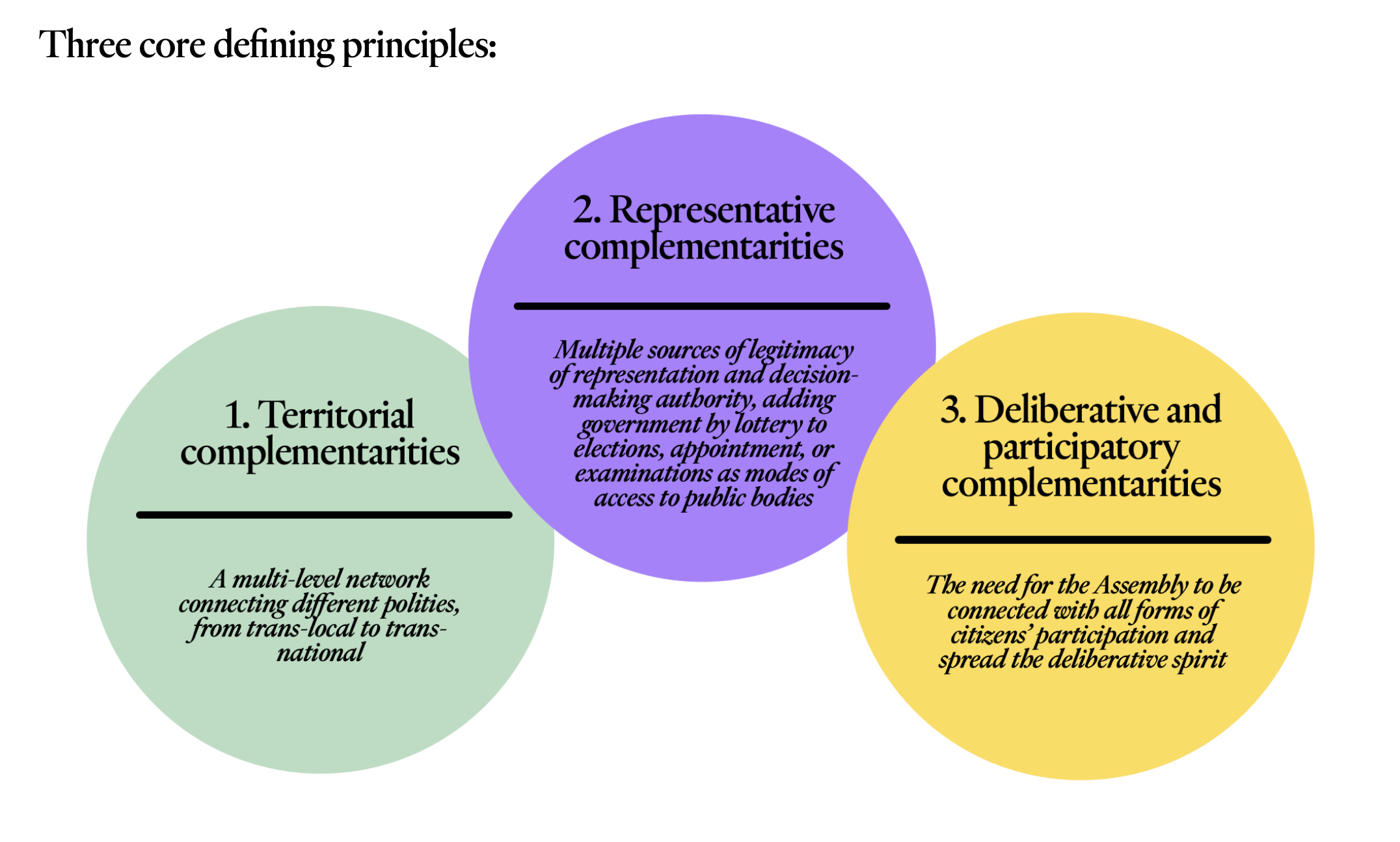
Figure 3: Three core arguments for an EU Citizens’ Assembly.
Territorial complementarities: A multi-level network connecting different polities, from trans-local to trans-national.
The EU Citizens’ Assembly will be a multi-level network of citizens’ engagement at the local, national, and transnational levels.
It will need to reflect the idea that constituent power in the EU lies at the same time with the European demoi, i.e., the citizens of the different member states, and an embryonic form of EU citizenship, while also taking root in political belonging represented by European cities. In the absence of a strong European public space, it will not bypass the national level, but instead build on it.
Therefore, contributions of local and national Citizens’ Assemblies must be substantially incorporated into the EUCA process without reproducing a system of delegations and mandate akin to traditional electoral chains.
Representative complementarities: Multiple sources of legitimacy of representation and decision-making authority, adding government by lottery to elections, appointment, or examinations as modes of access to public bodies.
The Assembly will need to confront the challenge of its relationship with the other branches of government and governance, especially national and European legislatures, which may fear a competing claim to ‘representativity’ – especially when people will inevitably start referring to it as a “fourth branch of government.”
The EU Citizens’ Assembly will constitute a form of non-electoral citizen representation, sometimes referred to as ‘descriptive representation’, completing rather than supplanting the classical form of electoral representation. Classic representative bodies in the EU, especially the European Parliament and Council, will come to understand that in sharing the power to ‘represent’, they will be led to refine what it means indeed to be present again to one another’s claims, interests, fears, and desires. And therefore, they will themselves benefit from a vast improvement of citizen trust in the European project.
Deliberative and participatory complementarities: The need for the Assembly to be connected with all forms of citizen’s participation and spread the deliberative spirit.
The Citizens’ Assembly should be a space that creates the epistemic conditions for high-quality deliberation, which in turn will push back against extremism and demagoguery by creating a space of learning with access to shared information, facilitated discussion, and an intention to find common ground.
This said, a deliberative Assembly cannot be pitted against other modes of citizen empowerment. Most EU governments nod to deliberation because they see it either as a substitute both to direct democracy and to dreaded referenda, or as a counterweight to organised civil society, especially civil society organisations about which most governments are diffident at best.
In contrast, we suggest that the EU Citizens’ Assembly be coupled at the European level with the European Citizens’ Initiative and other forms of direct and participatory democracy, while becoming a locus of empowerment for organised civil society actors through synergistic modes of opinion, considered judgement, and decision making. It will provide a deliberative filter before issues are put to a vote, be that in the European or national parliaments, or in referenda.
---
At the heart of these three requirements for best democratic practices is the triangle between electoral, direct, and deliberative democracy at various levels of governance, and the widespread arguments that these are fundamentally alternatives to each other. Part of the challenge for our EUCA is to instantiate ways in which the three logics and sources of legitimacy can be reconciled and synergised.
Five features
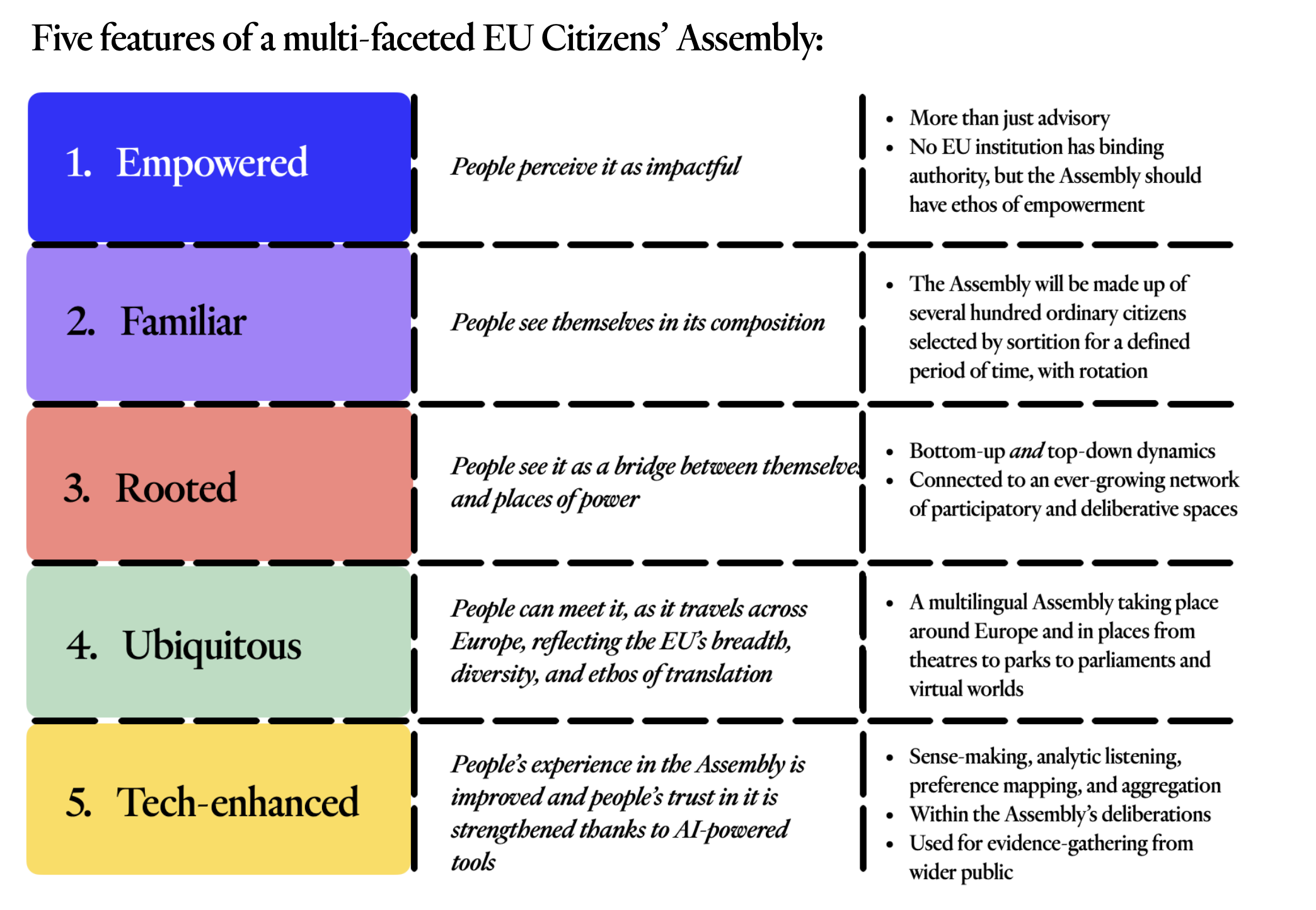
To operationalise these three core principles, we propose five key features that will define the Assembly’s “look and feel”:
Empowered: People perceive it as impactful
This means it should be more than just advisory. Or else it will raise false expectations and could be dangerously counter-productive.
None of the EU’s institutions has binding authority on its own, so we are conscious that the EUCA could not either. However, we suggest that the Assembly will operate with the ethos of empowerment, both for those participating directly and those connecting with its deliberations from the outside. Its deliberations should have real weight alongside the three other political institutions of the EU.
Familiar: People see themselves in its composition
Following the model of the Athenian tribunals, the Assembly’s Members could be drawn among a larger number of EU citizens (e.g. 50.000) selected by lottery each year at EU, national, and subnational levels in a highly visible and publicised manner. Much of the challenge will be to ensure that ordinary European people simply recognise themselves in the composition of this fluid body. Coming up with a truly inclusive lottery design and process at the transnational level is without doubt a significant challenge, but not impossible.
The criteria adopted for the stratified selection needs to consider both statistical representativeness and symbolic representation that appeals somehow to the imagination of the population. This in turn implies a public discussion on the fair criteria according to which the stratification takes place, as all statistical approaches can be contested. A pedagogy of sortition will be put in place through a radically transparent process.
In keeping with the philosophy of sortition, the Assembly will be made up of several hundred ordinary citizens selected by lottery to serve for a defined period of time through rotation.
To keep a balance of fresh perspectives and acquired know-how, one third of the Assembly’s Members would be renewed every four months. These exact numbers and timings are up for discussion: the premise we want to put forth is that a portion of the overall Assembly rotates on a regular basis.
Rooted: People see it as a bridge between themselves and places of power
The Assembly will be designed and evolve both from bottom-up and top-down dynamics, and therefore bridge the two worlds of civil society and formal institutions. Through the Assembly, EU institutions will be open to bottom-up initiatives for Citizens’ Assemblies which it will then discuss, adopt or amend. And conversely, civil society will have better access to the levers of power.
On the strength of its plurality and its bridging nature, the Assembly will clearly and visibly be interconnected with the ever-growing network of participatory and deliberative spaces around the continent, in towns and cities, in schools, workplaces and theatres, in political and corporate seats of power.
Moreover, the EU Citizens’ Assembly offers a space where citizens selected by lottery meet and debate with key stakeholders and experts who will have a fair and transparent opportunity to present evidence and engage with Assembly Members. In order to translate this spirit to the European level, the EU Citizens’ Assembly will work closely with various formal and informal civil society actors, trade unions, parties and the like with a transnational character.
Ultimately, the Assembly’s core features would together contribute to embed it in society at large, or rather in the many separate yet connected societies that compose Europe. In this spirit, its deliberations should connect with political negotiations conducted through opposing arguing and bargaining or preferably within an equitable procedural framework, to align deliberative practices with the practice of the reformers, practitioners, civil society actors, as well as with grassroots activists.
Ubiquitous: People can meet it, as it travels across Europe, reflecting the EU’s breadth, diversity, and ethos of translation
Crucially, the interconnected, rooted and popular character of the Assembly means eschewing headquarters in the Brussels bubble, with meetings instead also taking place in various places of debate and deliberation around Europe, from theatres to parks to local parliaments, where the EUCA would meet in various configurations, from smaller subgroups to plenaries, all the way to creating its own virtual worlds.
And why not imagine something more daring like a ship-Assembly, travelling on seas or on rivers, making the escales part of the interconnected journeys.
Of course, to be inclusive and locally grounded, the Assembly will be multilingual, as are the other three political institutions. Citizens must feel free to speak in their own language, but they can also select whatever language they wish. The rapid development of AI and translation technologies will make this easier and cheaper.
Tech-enhanced: People’s experience in the Assembly is improved and people’s trust in it is strengthened thanks to AI-powered tools
We see technology as having the potential to enhance the Citizens’ Assembly by helping to ensure its radical transparency, bringing the network of European Assemblies together, amplifying people's personal and community engagement, and creating a trustworthy archive of the process. New technologies are crucial for broadcasting the Assembly. In some methodologies, it makes it possible to “scale-up” participation by involving thousands of people at once, though it is arguable whether this is a desirable goal in itself.
Tech cannot replace the human or face-to-face with text-based forms of deliberation, but it can enhance the in-person and video deliberations that take place amongst relatively small groups of people, keeping in line with the core defining principles behind Citizens’ Assemblies.
Various co-authors are exploring themes on democracy and AI, including collaborations on developing new tech infrastructure for Citizens’ Assemblies that could help strengthen high quality of deliberation, including AI-powered sense-making, analytic listening, preference mapping, and aggregation.
This technology can be used both within the Assembly’s deliberations, as well as a way of gathering qualitative evidence from the wider public on the issue of the Assembly’s deliberation.
Finally, the digital archive with voice recordings (that require consent to be shared) and other analytical data can be used to enhance the public communication about the Assembly, as well as being something that helps generate trust in the process.
While the digital platform constructed by the European Commission to support the CoFE was an early experiment with using tech to support European Citizens’ Assemblies, it fell very short of fulfilling the purposes and goals outlined above, and lessons need to be drawn from this. This is not the primary focus of this paper, so we merely emphasise here the need to take into account new approaches to how tech and AI can enhance Citizens’ Assemblies in line with our co-authors’ deeper explorations of these themes.
Design variations
There will be many design considerations throughout this Assembly, as there have been for several years now around Citizens’ Assemblies in general. The challenge will be to adapt these to the EU context. These largely fall into three ‘buckets’ of questions:
Initiation: Multiple triggers
Who shall initiate deliberations, themes, processes (top-down, bottom-up, in between), and set the agenda? Crucially, the Assembly will be able and mandated to decide its own agenda. But this power of initiation ought to be informed by other pathways:
Elected officials and public authorities: The EU Council, Commission, or Parliament should be able to also initiate EUCA deliberations. Reflecting the CoFE process, initiated by the three EU institutions, which together form a representative system, the follow-up of the 2023 transnational Panels initiated by the Commission to advise it on policy making, as well as current initiatives by the European Parliament, these bodies could request and initiate specific debates of the Assembly. The difference with the status quo is that it would have an existing, ongoing, empowered, visible, and connected Assembly to go to.
Direct democracy: More radically, the Assembly could deliberate on an issue initiated by a successful European Citizens’ Initiative (ECI) or a referendum on the model the Oregon Citizens’ Initiative Review. The time will hopefully come when the ECI will become a real citizen initiative, leading to a referendum at large among the European people in which case the EUCA’s deliberation would intervene between the two.
More broadly, in the spirit of a “bridging Assembly,” and in order to fully apply the principle of participatory democracy enshrined in article 11 TEU, citizens beyond the Assembly itself should have ownership of the process of initiating debates for the Citizens’ Assembly. We could therefore imagine that networks and civil society organisations organise Citizens' Assemblies which are then “adopted” by EU institutions. The organised civil society could also be “entrusted” by the latter to convene Citizens’ Assemblies on a specific issue.
We can also imagine a network of national or sub-national actors together requesting that the Assembly debate a topic on which they will have reached localised conclusions. In the longer run, there will be a functional need to connect the demands for Assemblies emanating from different quarters.
Authorship: Variable configurations
Who shall be the authors of the recommendations, choices, stories that emerge: Assembly Members alone, or in collaboration with other representatives?
Many models exist as to processes of deliberation which we will not delve into here, having to do with the length and interval of meetings, the standards for framing the issue, the choice and role of experts and stakeholders, modes of facilitation, etc. Suffice to say that the Assembly’s approach will in part be a function of the upstream initiative process and the downstream decision process discussed here.
Here we simply want to highlight that while the Assembly would meet intermittently in plenary (some hundreds of people), Members could more often meet in subgroups and variable configurations drawn from the ongoing Assembly (or exceptionally composed anew on ad hoc basis). Each of these configurations would work on a manageable agenda and intervene at different stages of the EU policy-making or political cycle.
The Assembly will receive the help of facilitators for the discussion and the writing of proposals in order that all participants could have an equal voice, with the support of a technical staff and a Secretariat.
The Assembly and its Secretariat would serve as the hub for networked EU Citizens' Assemblies at various levels of governance and would ensure their necessary interconnection substantively so as not to operate in silos, for instance, through the sending of ‘Citizen Ambassadors’ between Assemblies.
Ad hoc Citizens’ Panels: These Citizens’ Panels would be the main configuration used by the Assembly to address specific issues over a limited period of time.
Monitoring Citizens’ Panels: In addition, Citizens’ Panels would be regularly organised to monitor some of the most important decisions taken by EU agencies which are often largely insulated from democratic control.
Citizens’ Panels at the local, regional, and national levels regarding decisions concerning EU funds: The Assembly will encourage the use of Citizens’ Panels at the local, regional, and national levels regarding decisions concerning EU funds — structural funds, cohesion policy funds, the funds related to the recovery plan, and the funds for the European Green Deal.
Ultimately, decisions taken at lower levels of government, concern a huge portion of the EU’s budget, and have a large impact on people’s lives. They are often couched in jargon (such as ‘cohesion policy’) that make it difficult for people to understand what this is, yet they often concern long-term investment decisions and influence some of the changes that are closest to people’s daily lives. At the moment, such decisions tend to be taken technocratically with little to no involvement of citizens.
There are already certain rules and regulations that outline stakeholder participation, and principles such as the ‘Partnership Principle’ when it comes to cohesion policy, for instance. We suggest that this principle could be revised to require Citizens’ Panels with Members selected by lottery to be involved in decision making on how cohesion policy funds get prioritised and spent. The successful example from Cantabria in 2021-22 demonstrates the feasibility and benefits of such an approach.
Mixed conferences and convention: Finally, on crucial questions related to the nature of the EU, specific conferences or conventions should be organised with a mixed membership constituted of citizens from the Assembly, MPs, MEPs, civil society representatives, representatives from the European Economic and Social Committee and the Committee of the Regions, deepening and improving modus experimented by the CoFE. This approach should be obtained if there is to be a Convention following the CoFE, as already endorsed by both the Commission and the EP. It would be crucial when a revision of the treaties will take place, a process that seems necessary in the perspective of the next enlargement of the EU to Balkan countries and Ukraine.
Decision making: Impact, authority, and accountability
Who shall ultimately decide: Other public institutions, Assembly Members, the citizenry at large?
Only time and experimentation will tell what kind of impact this Assembly will have. Will it restore the trust in democracy of all those who have felt aloof of the process or even those who still vote but without faith that their voice is heard? The new system will need to prevent the perennial shelving – which happens all too often undermining the meaning and purposes of Citizens’ Assemblies.
Formally, no single institution in the EU landscape can issue “binding” pronouncements. But the EUCA should not be only an advisory body, a kind of enlightened public opinion. We can hope that with time the Assembly will acquire gravitas in the court of public opinion and will benefit from the obligations of all others genuinely to take into account or indeed implement its recommendations. Their accountability in having done so are the first step towards impact. This is why we propose that the EUCA should in effect become a pillar political institution of the EU, with the same sort of weight and authority as the European Council, Commission, and Parliament.
The Assembly’s recommendations could be issued on a regular basis to inform the EU’s action and legislative priorities, or through resolutions sent to the European Parliament which it could adopt or reject with reasons.
Perhaps most innovative would be to explore the direct democracy pathway to impact where public opinion is asked to decide through popular votes. Against widespread scepticism in European circles, prior deliberation can in effect redeem direct democracy. For instance, EUCA recommendations following a successful ECI could be followed by pan-EU multi-referenda, including several topics, or better even preferenda (multiple-choice referenda with more than two yes/no options).
3: How do we get there?
How do we start thinking about strategies to make this vision a reality? Should we call for a cautious step-by-step approach or a moment of more radical change? Should this process itself be the object of a broad democratic debate?
An iterative process
As quoted at the beginning of this blueprint, the impulse for the process we are calling for has been the citizens themselves, randomly selected at the inception of the Conference on the Future of Europe. To quote fully:
Holding Citizens’ Assemblies periodically, on the basis of legally binding EU law. Participants must be selected randomly, with representativeness criteria, and participation should be incentivised. If needed, there will be support of experts so that assembly members have enough information for deliberation. If the outcomes are not taken on board by the institutions, this should be duly justified; Participation and prior involvement of citizens and civil society is an important basis for political decisions to be taken by elected representatives.
- Proposition 39, CoFE Citizens’ Panel on Democracy and the Rule of Law (December 2021). Proposal 36 (7), final CoFE declaration (May 2022).
In this spirit, the Citizens’ Panels organised by the Commission in the Spring and Fall of 2023 can be considered as the start of a process leading to an ongoing Assembly, or, on the contrary, a final destination, with the Commission content with fine tuning a process that it can best control.
The process of making participatory and deliberative democracy an ongoing and connected part of the EU system of institutions will be iterative and dynamic. It could and should evolve organically, as actors wrestle around these different modes of empowerment. After all, can we really argue that there is an ‘optimal design’ here? The challenge of combining bottom-up and top-down dynamics, or deliberative with direct democracy, cannot be designed ex-ante but will be an emergent property of different experiments and mutual learning, including by Citizens’ Assemblies that will learn from each other. And in the process, different, and potentially very contradictory, imaginaries will likely clash.
The legal basis
Since the EU is an institution defined by law and constitutionalised treaties, we need to examine carefully the legal basis for these proposals while at the same time opening up the EU to the creativity and collective intelligence of its citizens. The EU Citizens’ Assembly could be created in various ways: by a joint decision or inter-institutional agreement between the three existing EU institutions (as argued by the Bertelsmann Stiftung), by a Convention revising the treaties, by an EU referendum, or even as a result of an empowered EU Citizens’ Initiative.
A robustly designed EU Citizens’ Assembly requires a legal base, ideally in primary EU law, with clear and binding rules for it to hold an entrenched institutional status and impactful role in the decision-making process. Our argument has been that such an injunction may best be implemented through a continuous Assembly if it is not to be subject to arbitrary decisions on the part of EU institutions to turn on and off the tap of deliberative democracy.
The Convention, now proposed by both the Parliament and the Commission, might lead to Treaty change including an EU Citizens’ Assembly. This will be more likely if it itself includes citizens selected by sortition. But treaty change is a highly cumbersome process and unlikely at least in the short term. It is also not imperative to make progress given the existing article 11 TEU on participatory democracy. We can imagine, for instance, the progressive establishment of an institutional basis for an EU Citizens’ Assembly eco-system emanating from both a bottom-up and a top-down process.
Radical horizons
While the EU has always been committed to a step-by-step evolution, and while this is what is most likely to happen, we also need the momentum and inspiration provided by a more radical horizon. It will combine citizen empowerment by EU institutions and the kind of self-empowerment by citizens alongside formal and informal civil society which is, after all, the hallmark of democratic progress. We do not mean here to use empowerment in the paternalistic way that citizens will be bestowed power from the top. Instead, our vision needs to make room for the kind of democratic effervescence that is bound to be the sign of recovered democratic health in the EU and is often found in social movements and in the actions of formal and informal civil society.
Hence the two logics — top-down and bottom up — can be seen as being both in tension and in complementarity with each other. If the challenge is that of closing the gap between citizen participation and mainstream politics, their encounter must be managed in an organic way which leaves room for democratic improvisation. In other words, the journey to get us to a more participatory and deliberative future in the EU borrows both from approaches related to optimal institutional design and from more radical politics that are by definition a messy process that cannot be neatly encapsulated.
Elements of the vision we offer must remain bottom-up and cannot be neatly captured in a pre-ordained institutional design. Ultimately, the question before us is thus whether EU member states and institutions are ready for a leap of faith by creating a wedge where experimentation can happen. The experiment can start by operationalising it in specific area such as opening up cohesion and structural funds to deliberative budgeting by Citizens’ Assemblies, which can become the conduit for greater transparency and control. As citizens gain opportunities for political participation, learn from that participation, directly and indirectly, witness and enact impact, their motivation to take part in participatory and deliberative processes increases in turn. The diversity of participation offers and opportunities becomes a virtuous circle of cross-border engagement.
4: Conclusion
We have proposed in this short paper the idea of an EU Citizens’ Assembly becoming effectively a key branch of the EU’s government — a pillar institution taken as seriously as the European Council, Commission, and Parliament are today. By laying out the arguments for why we need this, considering the European specificities for its design, as well as core design principles and features, we have begun to sketch out an idea of how this might function and how it would connect into European public decision making.
In a broader context of democratic crisis and green, digital, and geopolitical transitions, we need to open up our imaginations to radical political change.
We need new ways to make systemic shifts that give people real agency and power in shaping the decisions affecting their lives, while creating the deliberative spaces that enable us to better grapple with the complexity of the issues we face today and do the hard work of finding common ground — especially across the cultural, linguistic, and political differences that we face across the continent.
Political and technocratic elites must start giving up some control and allow for a modicum of self-determination by citizens. Perhaps we can even imagine a world where this radical promise is better delivered by the EU than by its component member states and seen as such by citizens. If this came to be, there is no predicting how their political imagination can be fired up for the good of all.
Finally, it is clear that the foundations of the EU Citizens’ Assembly have already been laid, with the Conference on the Future of Europe, subsequent EU Citizens’ Panels, as well as experiments with Citizens’ Juries on Cohesion Policy and other deliberative Assemblies at all levels of government across the EU alongside bottom up initiatives. The world’s first permanent Citizens’ Assemblies at other levels of government, with Members selected by sortition, underpinned by a legal basis with connections to existing democratic institutions, are also mostly in Europe.
We are not starting from scratch. There is a robust evidence base and many learnings to build on if we want to take the next ambitious and courageous step towards more democratic and innovative forms of governing ourselves in the EU.