This is one of two reflection essays that we published about multilingualism in June 2026.
Read the other one by Hugh Pope, ‘Do Multilingual Citizens’ Assemblies Work?’ here.
How to cite this paper: MacDonald-Nelson, James, and Hannah Terry (2026). “Deliberation in Europe’s Most Multilingual Country”, DemocracyNext.
Free to share under CC BY-NC-ND 4.0 - see our sharing policy.
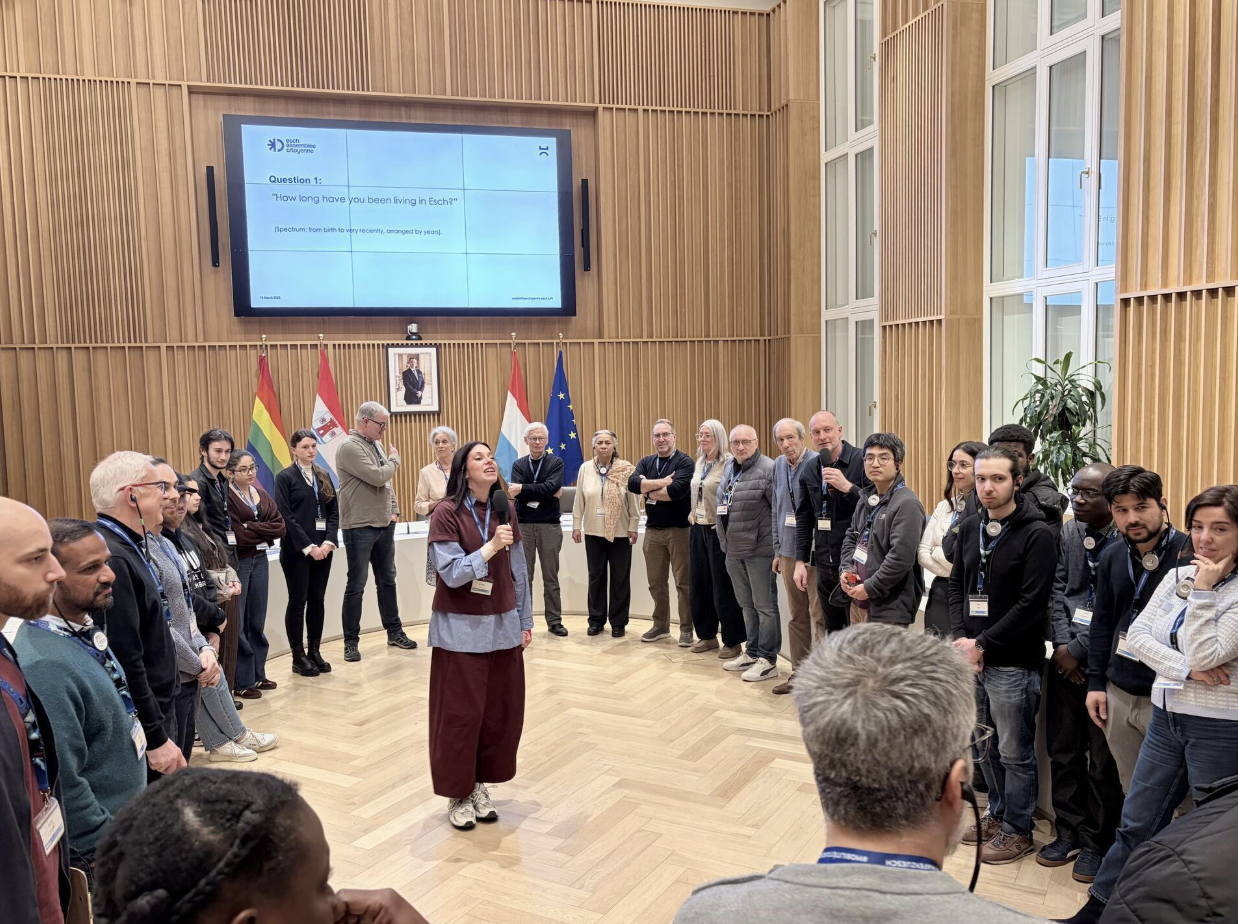
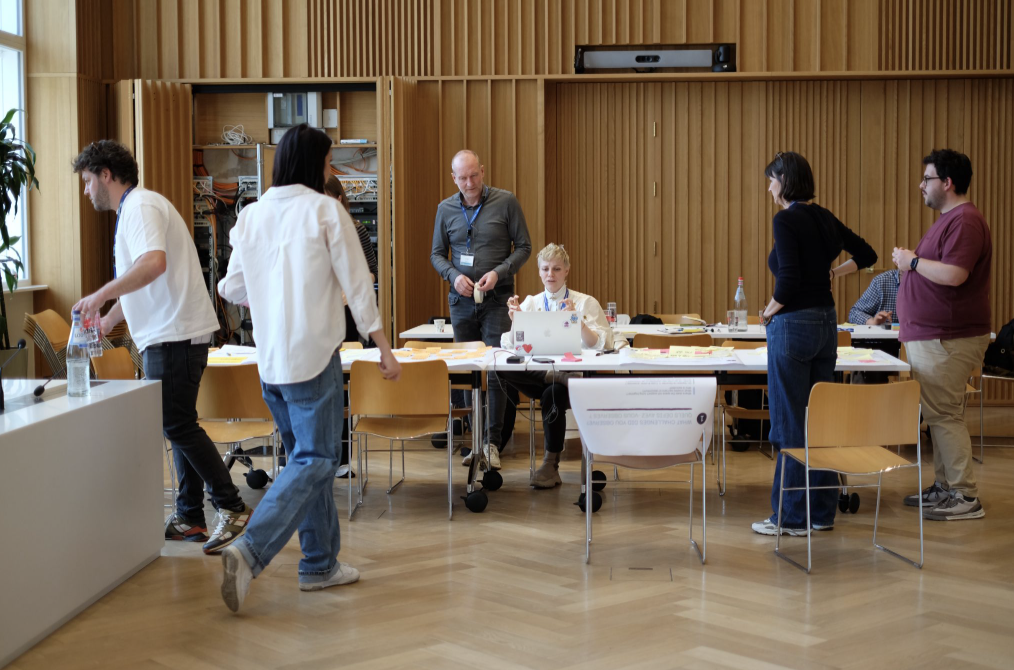
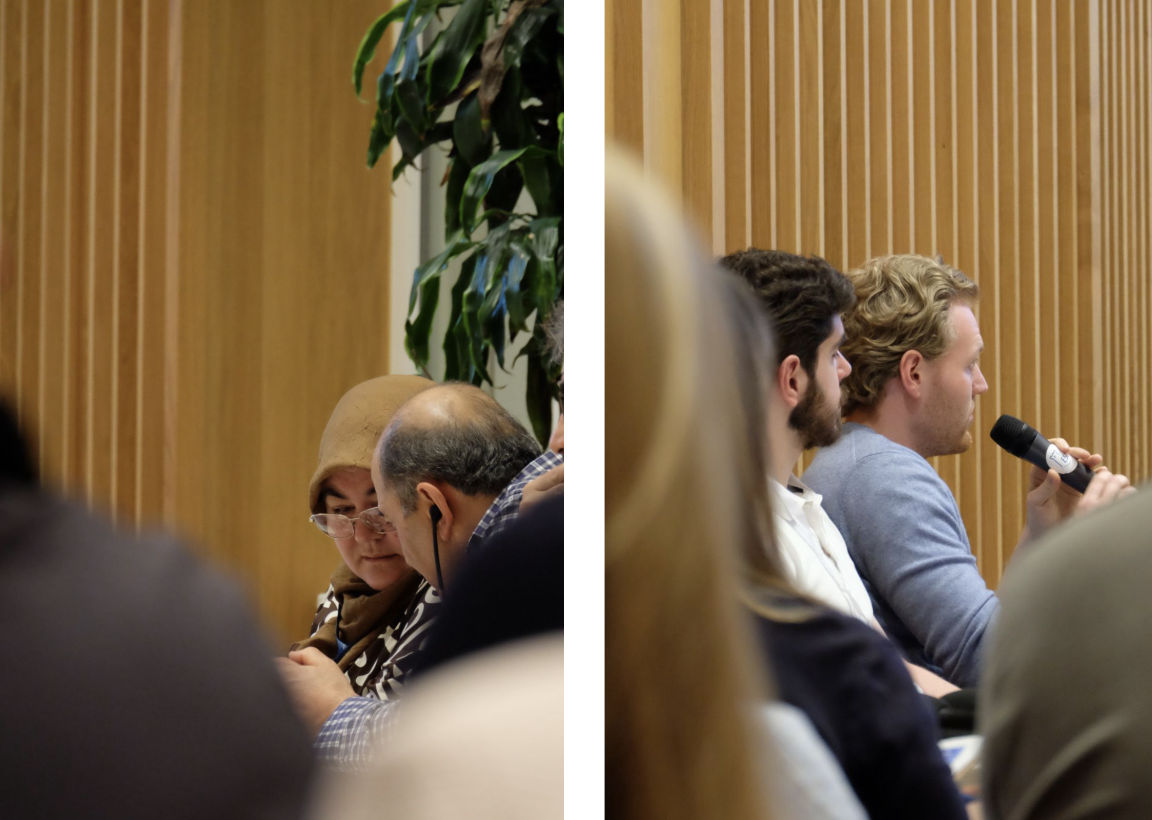
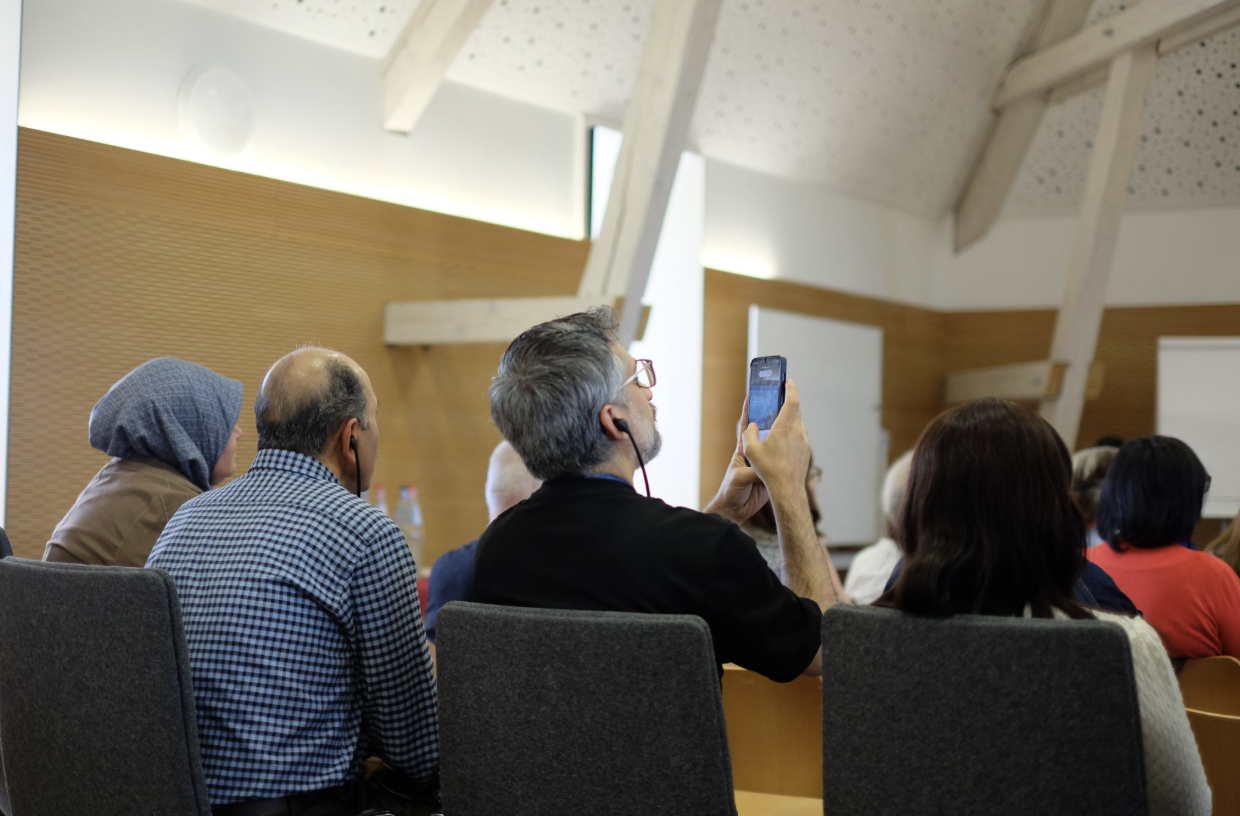
Walking into a session of Esch-sur-Alzette’s citizens' assembly, one of the first things that struck us is the multitude of languages being spoken. People are comfortably exchanging with each other in French, English, and Luxembourgish. Listening more carefully, we heard someone speaking quietly to the person sitting next to them, interpreting between French and Turkish, and another between French and Arabic.
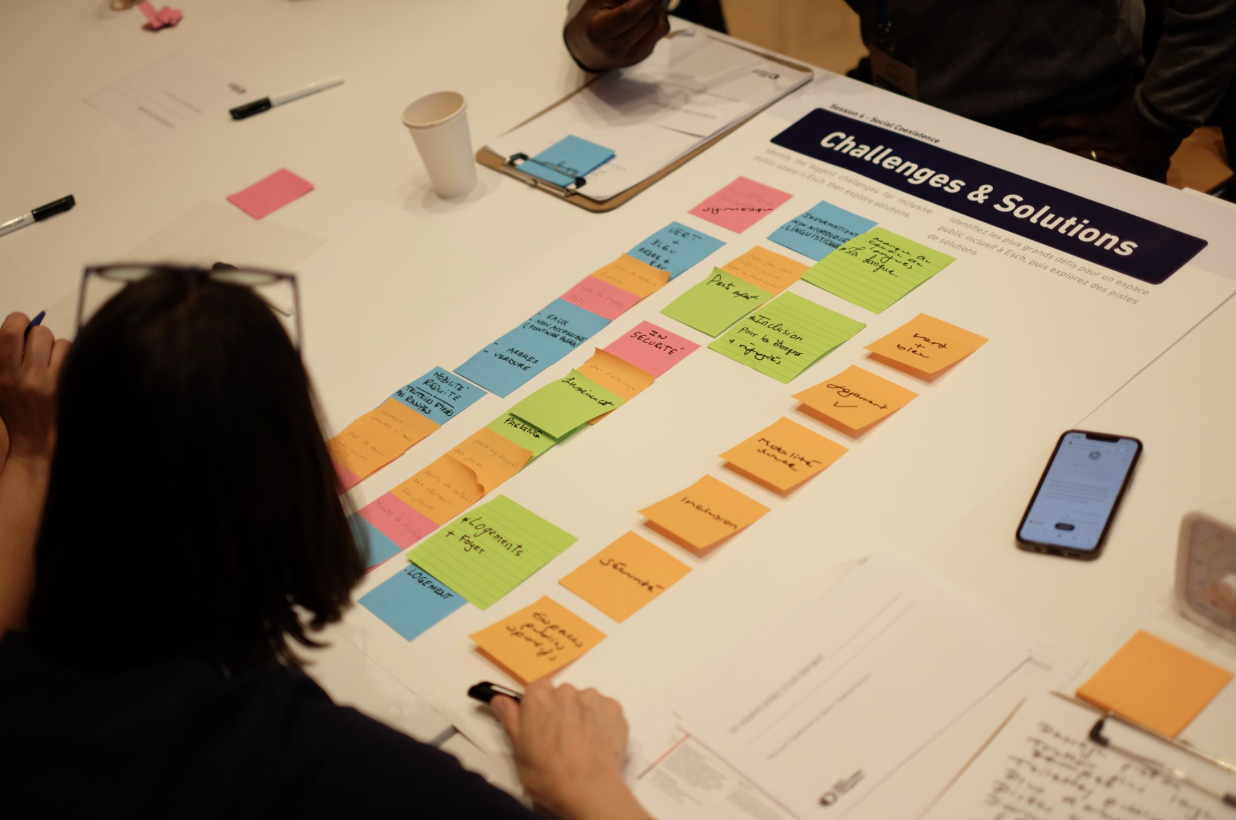
During the breaks, over coffee or lunch, a few people switched between Portuguese, Spanish, and Bulgarian. During small group discussions, a phone was placed in the middle of each table, quietly running Dembrane's AI-supported deliberation platform. It was listening and transcribing each conversation in that table’s language. Assembly members and facilitators shared their outputs in their chosen language while transcriptions were live-translated.
This is what a multilingual, tech-enhanced citizens’ assembly looks like.
This atmosphere of multilingualism is typical in Esch - Luxembourg's second largest city, home to 38,000 residents - and is a clear reflection of the country's incredible linguistic diversity. Luxembourg recognises three official languages (Luxembourgish, French, and German), yet its linguistic reality is even richer: 99% of residents can hold a conversation in at least one foreign language, 91% in two, and 76% in three, making it the most multilingual country in the European Union according to a 2024 report by the European Commission. In Esch, there are over 8,000 Portuguese speakers, and Serbian, Arabic, and Turkish are also commonly spoken.
Given that multilingualism in Luxembourg is the rule, not the exception, assembly facilitators, Snakke & Co. were well prepared to deliver a process in multiple languages. Their team includes native speakers in German, Luxembourgish, French, English, Dutch, Italian, and Portuguese, and all of them speak at least one or two other languages.
The assembly of 40 randomly selected Esch residents convened to deliberate on the future of Esch, focusing on questions about how to support the most vulnerable, how to improve the design of its public spaces, ensuring sustainability in the face of climate change, and how the city might govern in closer collaboration with its diverse residents. The facilitators ensured that assembly members could comfortably deliberate on such important topics across multiple languages - a task that required careful consideration.
Choosing a working language
We’ve been working with the City of Esch and Cultures of Assembly (a programme led by Markus Miessen, Chair of the City of Esch and Professor at the University of Luxembourg) for the past 18 months on capacity building and co-designing the citizens’ assembly. From the start, it was clear that for Esch’s citizens’ assembly to be truly representative, it would need to be accessible in multiple languages. From the public communications campaign, to the assembly website, and the 10,000 invitation letters sent to residents - everything was translated into Luxembourgish, French, German, Portuguese, and English.
Even though it was impossible to predict exactly which languages would need to be integrated into the process, linguistic diversity was seen as a strength, not a challenge to be avoided. Linguistic diversity, when embraced as a design principle from the start rather than accommodated as an afterthought, can produce inclusive and high-quality deliberative outcomes. That choice shaped everything that followed: who showed up; how people deliberated, and the recommendations they drafted.
Previous participation processes have not always reflected this diversity. But this assembly has been different, says lead facilitator from Snakke & Co., Liz Thielen. She notes that selecting a single working language before the assembly has even begun can discourage people from joining and sends a message about who is invited to be part of the process. The Esch assembly set a different tone from the outset - one built around the decision that residents with diverse backgrounds and perspectives all belong in the room.
Being flexible, adapting to the circumstances
This doesn't mean the process of hosting a multilingual assembly has been easy. It has required improvisation, adaptation, and experimentation. Nobody knew exactly who would walk in until the assembly members were selected. While the facilitation team was well prepared to deliver the process in multiple languages, it’s not always straightforward to decide how this works on the ground. While plenary presentations were live-translated by interpreters (provided by local organisation ASTI - Association de Soutien aux Travailleurs Immigrés), the initial plan was to mix language groups during small group discussions and have a facilitator and assembly members translate between them. This was much easier in theory than in practice.
Constant interpretation often slowed down the flow of conversation. Some assembly members were hesitant to speak. The dynamic that makes small group deliberation work - quick exchanges, an emerging thought, the half-formed idea that someone else finishes - was more difficult in practice. As Thielen noted, "you can design and prepare as much as you want, but it's only once you're in the room that you get a sense of what's possible."
After the first session, facilitators decided to change things up and organised small groups based on language. For some, this meant that they could always count on working in the language they knew the best. On the other hand, assembly members who were comfortable in multiple languages switched between groups more easily.
"Most people choose comfort over new experiences," Thielen observed, not as a criticism, but as a design constraint to consider. Within each language group, assembly members were often diverse in other ways. The group speaking Luxembourgish, for instance, included some of the youngest and eldest assembly members, representing a diversity in generations. A Turkish speaking member whose husband provided interpretation remained in French speaking groups, but brought the perspective of a newcomer to Luxembourg to the discussions. Diversity within language groups, Thielen points out, matters as much as diversity between them.
The impact of technology
The Esch citizens’ assembly is one of the first to integrate Dembrane into the process, enabling a new type of process design regarding multilingualism. This AI-supported deliberative technology is a platform that listens to, transcribes, highlights, and synthesises small group conversations. When prompted, it can also translate conversation transcripts and summaries, making it easier to share the outputs from small group discussions taking place in multiple languages with the whole assembly. Dembrane does not aim to replace human interpretation; there are things only a person in the room catches that no tool will. But it allows the facilitators to focus on supporting the conversations without pausing to ensure every word is captured on paper - and if they missed anything, they could refer back to the transcripts.
This is the first time that Dembrane is being used in a multilingual setting with more than two languages. While the platform was not necessarily designed with multilingualism in mind, facilitators quickly discovered how useful it can be. Before small group discussions begin, each facilitator opens Dembrane on their phone by scanning a QR-code which links the outputs of the conversation to a centralised interface. This can be viewed on a laptop and compiles all small group discussions taking place at once.
During the assembly this was monitored closely by Evelien Nieuwenburg (co-founder of Dembrane) alongside lead facilitator, Liz Thielen, to ensure each group was connected properly. With the Dembrane app running, a phone is placed at the centre of each group. It passively listens and transcribes the conversation, tracking what was said without identifying the speaker. When assembly members want to express something without it appearing in the transcript, they simply pause the recording using the app on the phone. At the end of every small group discussion, assembly members and facilitators worked together to check the analysis generated from their conversation transcript. They used Dembrane’s ‘verify’ feature which allows the user to edit anything in the analysis that might have been misrepresented or misunderstood by the platform.
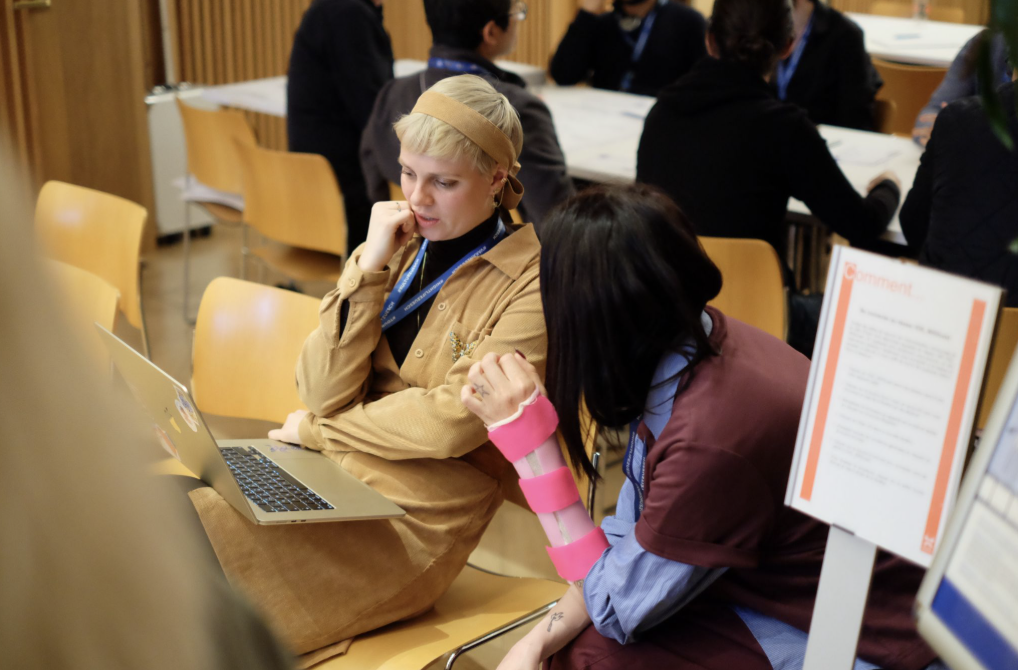
These analyses could be translated directly within Dembrane’s platform and were used in plenary discussions at the end of every assembly session to share back to the larger group as they concluded the topic of that day. They were also used amongst facilitators to track what the other small groups were discussing. For example, one facilitator did not speak French, but could read the analysis of French-language group discussions as Dembrane's output translated them into English immediately.
Beyond Dembrane, other technologies also played a role. Translation apps, though sometimes slow, helped assembly members to fully express their thoughts when they struggled to articulate themselves in a second or third language. Across the board, the facilitators agreed that welcoming technology has been a significant support in navigating the assembly’s multilingual dimensions.
What Esch can teach other practitioners
Although the assembly is still ongoing and its recommendations are not yet finalised, from what we’ve seen so far, there’s a lot to learn from the multilingual deliberation taking place in Esch.
One is to commit to multilingualism from the start. The absence of a single designated working language was key. It shaped who responded to the invitation, who felt welcome, and who showed up. This created a more representative group than any single-language process could have. It demands more preparation, more flexibility, multilingual facilitators, and a willingness to adapt, but it has resulted in an assembly that mirrors the city it is meant to represent.
The second lesson is to always be prepared to adapt to the assembly members’ needs. The original plan to mix languages in small groups did not work as expected. When it was clear that facilitators needed to respect people’s comfort level, small groups formed that were diverse in different ways. While the older and younger generations of Luxembourgish speakers worked together, those who were comfortable in multiple languages switched between groups.
As Lisa Verhasselt, an evaluator from the University of Luxembourg pointed out, "it requires constant effort and attention, it has to evolve. You cannot say: we decided this and we are sticking with it." Checking in with assembly members, formally and informally, is how to ensure that a multilingual process keeps working for everyone in the room.
Lastly, integrating technology can be a huge benefit to both facilitators and assembly members. Dembrane gave the Esch assembly something it would not otherwise have had - a way to easily and quickly communicate the outputs of each small group discussion across multiple languages. In turn, this reduced the pressure on the facilitators and helped assembly members see their contributions reflected back in their own words. The assembly still needs people in the room who can follow and intervene in multiple languages, but integrating Dembrane helped reduce the facilitators’ cognitive load and allowed for assembly members to work together more fluidly.
Esch isn’t the first, and won't be the last, to grapple with the question of how to make deliberation work across multiple languages. But it does offer something rare - evidence that linguistic diversity, when treated as a design principle rather than a logistical headache, can produce a more inclusive assembly. The lesson isn't simply to invest in good interpretation or the right technology, though both matter. It is that the decision not to designate a working language is itself a democratic act, one that signals the openness of who belongs in the room before a single assembly member has walked through the door.